

A DOY audit is one of the biggest fears for any freelancer or e-shop owner operating with a digital or virtual registered office. “What happens if the tax office audits me?” is the most common question we hear. The truth is that the outcome of a DOY audit doesn’t depend on luck, but on how your registered office is set up. In this guide you’ll see exactly what a DOY audit checks, where digital offices are exposed, and how a physical registered office covers you completely.
What a DOY audit is and when it happens
A DOY audit is the process by which the Greek tax office confirms that a business operates legally and that the details it has declared are true. It can happen for several reasons: random sampling, data cross-checks, a complaint, or as part of a start-up or amendment.
A large part of any DOY audit concerns the registered office. The tax office wants to verify that the declared address corresponds to a real space. This is exactly where many digital or virtual offices fail, while a properly structured physical office passes a DOY audit without trouble.
What the DOY checks in an inspection
In an audit or on-site inspection, the inspector wants to confirm a real presence at the declared address. Specifically, they look for:
- a space genuinely connected to the business;
- signage or a company name that identifies the activity;
- a legal lease or right to use the space;
- evidence that the office is not just a name on a list.
When these exist, a DOY audit is completed smoothly. When they’re missing, the problems begin.
Digital office and DOY audit: where the risk is
The term “digital office” isn’t bad in itself. The problem arises when a digital office has no physical substance. An address that exists only on paper, with no locker, signage or right to use space, is vulnerable in a DOY audit.
By contrast, a digital office backed by a real space — like OfficeBooking.gr — combines the convenience of remote management with the security of physical presence. So even if a DOY audit comes, there is something real for the inspector to see.
Why simple mailboxes get rejected
A P.O. box or a “mail-only” address is often not accepted as a registered office, because it proves no physical substance. In a DOY audit, such a solution offers no evidence of operation.
That’s the source of most rejections and headaches: the business thought it had a legal office, but in practice couldn’t prove its presence. The difference between a simple mailbox and a physical office with a locker is decisive for the outcome of a DOY audit.
How the OfficeBooking.gr model covers you
The OfficeBooking.gr model is designed specifically to withstand a DOY audit. It rests on four elements:
- Electronic lease on Taxisnet: a legal lease accepted by the DOY for starting or amending your business.
- Personal locker with your business name: a physical, named presence in the space.
- 4 hours of shared desk per month: a documented right to use the office, inside the contract.
- Mail handling: every document from the DOY reaches you the same day, scanned.
With these four elements, your office has substance — not just an address. A DOY audit becomes a simple formality.
Step by step: what to do if a DOY audit comes
- Stay calm — a DOY audit is a routine procedure, not an accusation.
- Have your electronic lease and office details ready.
- Show the physical presence: the locker with your name and the space you can use.
- Coordinate with your accountant for any extra document requested.
When your office is properly structured, you don’t need to worry about any DOY audit.
What the legal framework says
Declaring a registered office in Greece is done through the registry of the AADE and Taxisnet. The law doesn’t forbid using flexible or shared spaces as an office; it requires the address to correspond to a real space you can use and that relates to the business. In a DOY audit, that is exactly what’s examined.
So a solution with an electronic lease and a physical space is fully compatible with the framework, while a plain paper address risks being judged insufficient.
What happens if an office fails a DOY audit
When an office doesn’t prove physical substance, the consequences of a DOY audit can be serious — from fines to challenges over the validity of the office, problems issuing invoices, and complications with the business registry (GEMI).
In the worst cases, the tax office may retroactively dispute the operation at that address. The “saving” from a cheap virtual solution evaporates against the cost and time of recovering from a problematic DOY audit.
Real scenarios: freelancer, e-shop, dropshipper
A freelancer working from home often doesn’t want to declare their residence as an office. A physical registered office gives them a professional address that stands up to a DOY audit without exposing their home.
An e-shop or dropshipper needs an address for invoices, GEMI and partnerships, but usually has no warehouse or office. An office with a locker and a right to use space covers this need and survives a DOY audit at the same time.
How mail handling protects you
Much of the communication with the tax office happens in writing. Notices and documents arrive at the declared address. If it has no organised handling, you risk missing an important deadline and being exposed in a later DOY audit.
With daily mail handling, every document is scanned and forwarded to your email, while originals are kept in your locker. You never miss a notice and are always prepared.
Digital office with substance vs a plain address
| Criterion | Plain address | Physical office (OfficeBooking) |
|---|---|---|
| Survives a DOY audit | Low | High |
| Physical presence | No | Yes (locker) |
| Taxisnet lease | Rarely | Yes |
| Mail handling | No | Daily |
| Cost | Low | €59.90/month |
Preparation checklist for any inspection
The best defence is preparation. With a simple checklist, you’re always ready when the tax office knocks:
- Electronic lease posted and accepted on Taxisnet.
- A named locker that identifies your business in the space.
- Recent invoices and activity records, organised.
- Contact details up to date in the registry.
- Instant access to your scanned mail.
When the above are in place, an inspection becomes a simple confirmation rather than a stressful experience.
Sampling or targeted? The forms of a tax audit
Not all tax audits are the same. Some arise from random sampling, others from data cross-checks, and others are targeted — for example after a change of registered office. In every case, the common thread is verifying real presence.
That means it isn’t enough to be “technically fine” on paper; you need an office that stands up in practice. A physical solution with a locker and a usable space covers you regardless of the form the audit takes.
Common misconceptions about a DOY audit
A common misconception is “if my business is small, it will never be audited”. In reality, data cross-checks involve businesses of every size, and a DOY audit can arise even for a brand-new sole proprietorship.
A second misconception is “as long as I pay my taxes, I’m fine”. Tax compliance matters, but it doesn’t remove the need for a valid office. The tax office separately examines whether the declared address corresponds to a real space. Finally, many think changing an office is complicated; in practice, with an electronic lease, it’s quick and remote.
The cost of a secure, legal office
Many professionals delay moving to a legal office, fearing the cost. In reality, a physical registered office starts from €59.90 per month — about 1/10 of the cost of an office. Compared with the fines and disruption of a problematic audit, the difference is enormous.
The logic is simple: you pay a small, predictable monthly amount and gain peace of mind against any future DOY audit. It’s an investment in the stability and legality of your business, not just another expense.
Why physical presence boosts your credibility
Beyond the tax office, a real professional address matters to third parties too. Clients, suppliers and banks see a stable address and perceive a serious, organised business. This credibility translates into easier partnerships and a better image in the market.
So investing in a legal, physical office doesn’t only protect you against the tax authority; it builds the trust you need to grow your business safely.
Frequently asked questions about a DOY audit
How often does a DOY audit happen?
There’s no fixed frequency. A DOY audit can be random, follow a data cross-check, or come as part of an amendment. That’s why structuring your office correctly from the start matters.
Will I be notified before the audit?
Not always. The tax office can inspect without warning, which is why physical presence must exist at all times.
Is a digital office covered in a DOY audit?
A digital office with real physical substance, a locker and a lease is covered. A purely virtual address with no substance is exposed.
What if I’m not present at the moment of the audit?
You don’t need to be in the space constantly. What matters in a DOY audit is the existence of a real, named presence — the locker and the space — along with the legal documents of the office.
Does the audit differ for a sole proprietorship and a company?
The logic is the same: the tax office confirms real presence at the declared address. The exact requirements may vary by legal form, so coordinating with your accountant is always useful.
How often does a DOY audit happen to small businesses?
There is no fixed schedule. A DOY audit can be triggered by risk-scoring algorithms, VAT refund claims, customer complaints, or random sampling. Freelancers and e-shops with a bare mailbox address are statistically easier targets, because a failed on-site verification (autopsia) is quick to establish. A seat with real physical presence — a named locker, a Taxisnet-registered lease and desk access — removes the easiest ground for rejection before the inspector even opens your books.
Can I pass a DOY audit while working from home?
You can declare your home as a seat, but it mixes personal and business exposure: inspectors may visit your residence, landlords often refuse business use, and the address appears on every invoice. A separate professional seat from €59.90/month keeps your home private and gives the inspection a clean, verifiable location with your company name physically present. For bookkeeping questions that follow an inspection, always involve your accountant.
The advantage of an office in Heraklion
Our office is located in Heraklion, Crete, in a real working space. In an inspection, there is a specific, verifiable address bearing your business name that an inspector can visit. It isn’t an abstract “digital” location, but a place where your presence can be confirmed.
This local footprint, combined with remote management, gives you the best of both worlds: a stable physical office and full flexibility in your daily work, wherever you happen to be.
A practical savings example
Consider a freelancer who would rent a small office at €400 a month — that’s €4,800 a year before deposit and utilities. With a physical office at €59.90, the annual cost falls to about €719. Over €4,000 a year stays in the business, while the legal coverage remains intact.
For an e-shop or dropshipper, the saving is even clearer: you pay only for what you truly need — a legal, credible address that holds up under scrutiny.
DOY audit timeline: from notification to the final report
Most on-site inspections follow a predictable arc. First comes selection: your AFM is flagged by risk criteria or sampling. Then verification: an inspector visits the declared seat, often unannounced, to confirm the business genuinely operates there. They look for the company name on the premises, someone who can answer for the entity, and consistency between the declared address and physical reality.
If the visit raises doubts, a written request for records follows, and you typically have a short statutory window to respond. The process closes with an audit report that either confirms your status or proposes corrections and fines. The single cheapest way to shorten this timeline is to make step two undramatic: when the inspector finds a real seat — locker with your company name, registered lease, staffed premises — the on-site part usually ends the same day.
The documents that decide a DOY audit outcome
Inspectors decide on paper as much as on presence. The documents that consistently matter for the seat question are: the lease or concession agreement registered on Taxisnet, proof the agreement is active and paid, the company’s display at the premises, and correspondence showing the address is genuinely used — received mail, forwarded notices, courier logs.
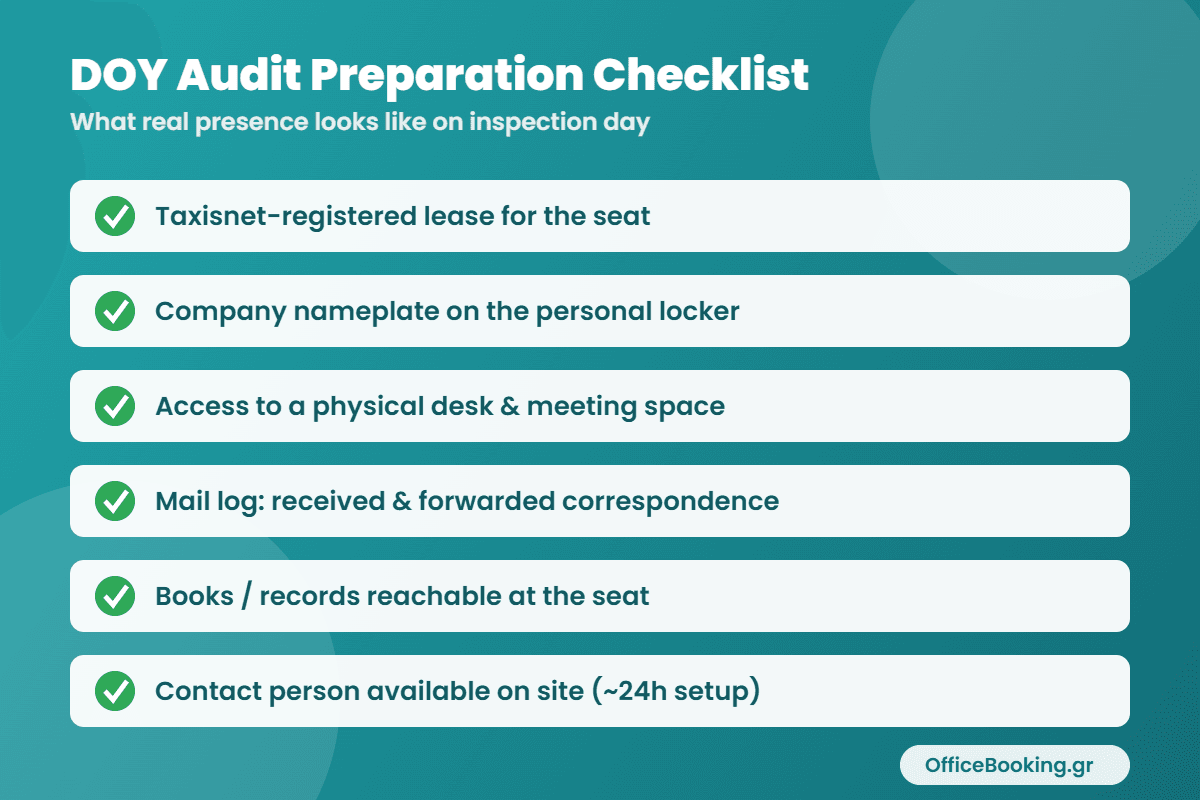
With OfficeBooking.gr each of these exists by design: the concession is registered on Taxisnet when your seat is activated (usually within ~24 hours), your personal locker carries the company name, and mail handling produces a paper trail of real use. Keep tax filings and accounting records with your accountant — those are outside the seat service — but make sure they can be produced quickly when the report window opens.
Home seat, bare mailbox or OfficeBooking: your options compared
Before choosing where to declare your seat, compare what each option gives you on the day an inspector shows up:
| Criterion | Home seat | Bare mailbox | OfficeBooking.gr seat |
|---|---|---|---|
| Survives on-site verification | Usually, but exposes your home | High rejection risk | Yes — real premises, named locker |
| Taxisnet-registered lease | Depends on landlord consent | Often missing | Included |
| Monthly cost | “Free” but privacy cost | €20–40 | €59.90 (€48.30 + 24% VAT) |
| Desk & meeting access | Your living room | None | 4h/month shared desk |
| Privacy on invoices | No — home address public | Yes | Yes |
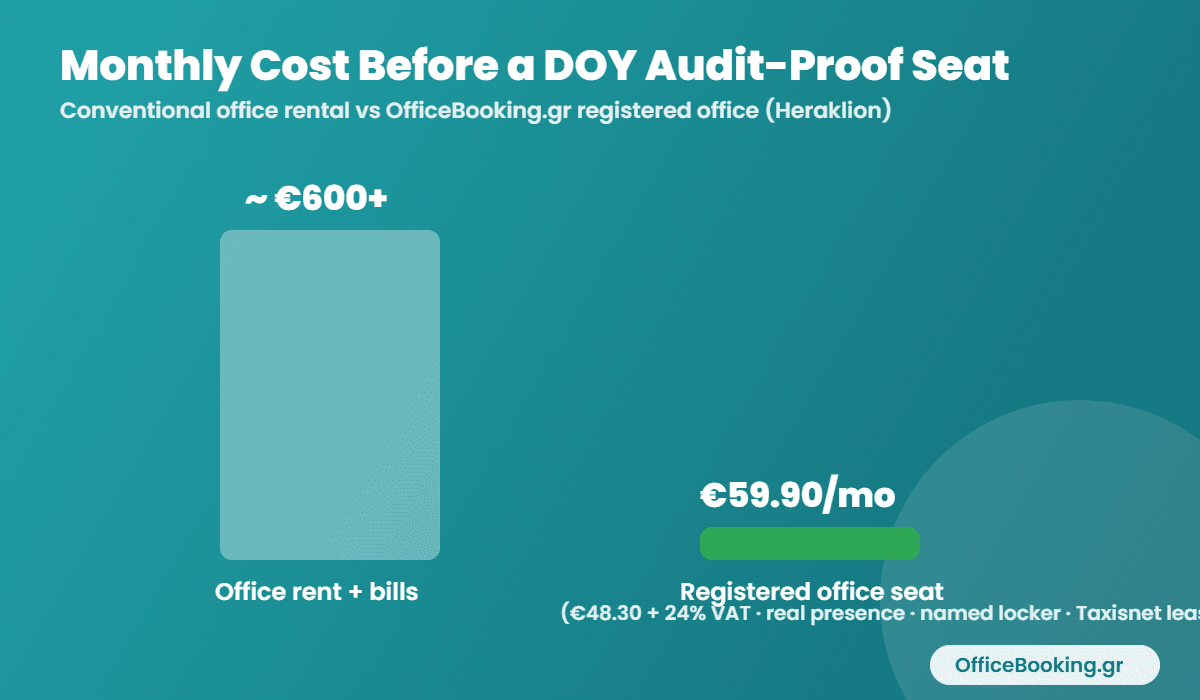
The pattern is consistent: a mailbox saves a few euros per month and risks the entire outcome of a DOY audit; a conventional office passes but costs roughly ten times more. A registered office with genuine physical presence sits in the middle — audit-ready at about one tenth of the cost of renting, active in about 24 hours, at Anaxagora 23, Heraklion, Crete.
After the DOY audit: keeping your seat audit-ready year-round
Passing one inspection does not archive the risk. Re-audits happen, especially after VAT refunds, address changes or activity-code updates. Treat audit-readiness as a standing property of your seat rather than a one-off scramble: keep the Taxisnet concession active and renewed, keep the company name visible on your locker, and keep the mail log growing — every forwarded notice is dated evidence that the address genuinely operates.
This is where a monthly, contract-light model helps. Because the OfficeBooking.gr seat renews month to month from €59.90, your registered address stays continuously valid without a long lease locking you in, and the physical infrastructure — locker, shared desk, staffed premises in Heraklion — is maintained for you. Your only recurring tasks are the ones that belong to your accountant anyway: filings, books and payroll. The seat itself stays quietly ready for whichever inspector arrives next.
Conclusion
A DOY audit isn’t something to fear, as long as your office has real substance. With an electronic lease, a personal locker and organised mail handling, you’re covered. Read about the virtual vs physical office difference, see our FAQs, or contact us about your case. This information is provided for general guidance; always consult your accountant.