

Deciding to change your registered office in Greece is a step many founders postpone, treating it as a minor formality. In 2026, with tax checks increasingly focused on physical presence, changing your registered seat (φορολογική έδρα) the right way protects you from a failed audit. This guide walks foreign and local founders through why, when and how to move your seat safely.
What It Means to Change Your Registered Office in Greece
Your registered office is the official legal address of your company on Taxisnet and in the GEMI registry. Changing it means updating that declared seat to a new location, along with any records that reference the old address. It is a legal update, not just a change of correspondence.
The tax and accounting side of the change is handled by your accountant. The part that trips people up is the address itself: the new seat must be real and defensible. That legal physical presence is exactly what we provide.
Why Founders Change Their Seat
There are many triggers: outgrowing a home address, ending a problematic lease, restructuring, or simply realising that an apartment is not a safe place to keep declaring as a business seat. Whatever the reason, the goal is the same — to move to an address that will hold up under scrutiny.
The End of the Home-Address Seat
Using your home as your registered office is common but risky. It exposes your private address publicly, often requires landlord permission, and ties your company’s legal location to wherever you happen to live. When you decide to change your registered office in Greece, moving away from a home seat is usually the smartest move you can make.
Change of Seat: The Step-by-Step Map
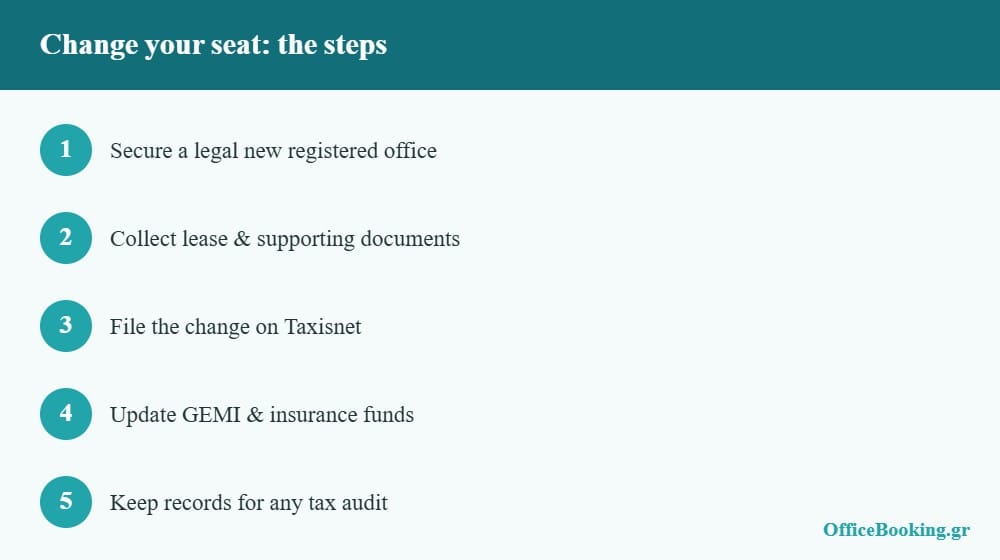
The process is straightforward once the address is sorted. First, secure a legal new registered office with real physical presence. Second, gather the lease and supporting documents. Third, have your accountant file the change on Taxisnet. Fourth, update GEMI and any insurance funds. Fifth, keep records on hand for a possible audit.
Documents You Will Need
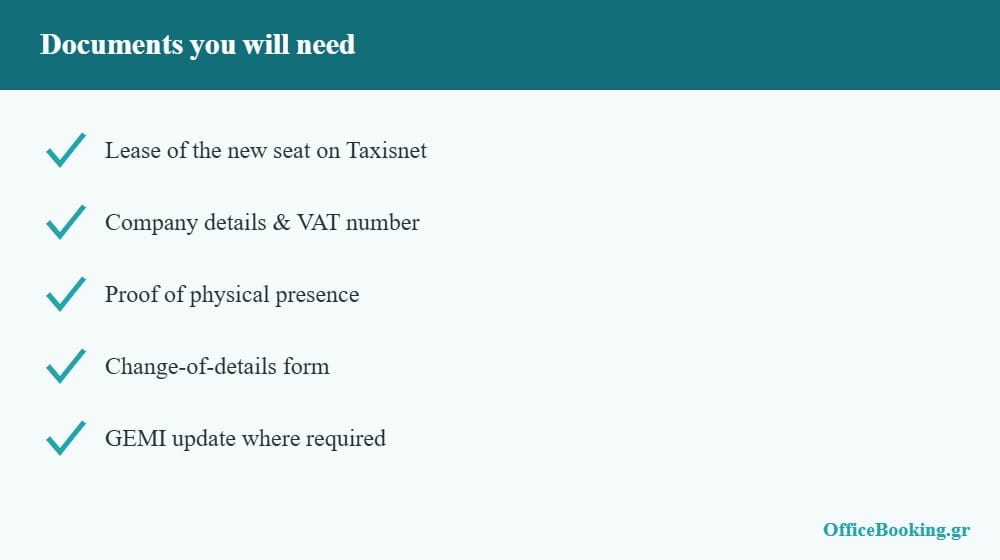
Typically you will need the lease of the new seat as filed on Taxisnet, your company details and VAT number, proof of physical presence at the location, the change-of-details form, and a GEMI update where required. With an organised provider, most of this paperwork is prepared for you.
Why the Change Requires Real Physical Presence
The reason to be careful is the on-site audit (autopsia). If you change your registered office in Greece by moving to a paper-only virtual address, an inspector who visits and finds no genuine presence can treat the seat as fictitious. That defeats the entire purpose of the change and can bring penalties.
Our seat is built to survive that check: a personal locker with your company name, a shared desk you can use, and a lease registered on Taxisnet at Anaxagora 23 in Heraklion. The new address is real, so the change stands.
What Your New Registered Office Includes
When you move your seat to OfficeBooking, you get genuine legal presence rather than a mailbox. It includes a named locker, four hours per month of shared office use, and a proper Taxisnet-registered lease at Anaxagora 23 in Heraklion, Crete. Mail arrives in your company’s name and the space can be shown to an inspector.
The cost starts from EUR 59.90/month (48.30 + 24% VAT), around one tenth of a small office, billed monthly and active in roughly 24 hours.
Cost of Changing Your Seat
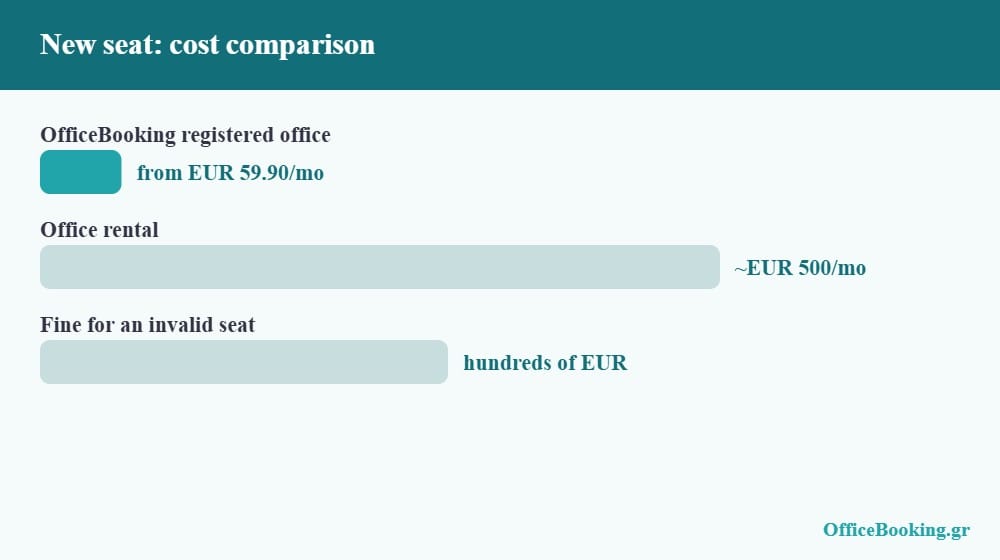
Compared with renting premises or risking a fine for an invalid seat, a legitimate registered office is inexpensive. From EUR 59.90/month with no long commitment, the change becomes an investment in security rather than a cost, one that pays for itself the first time you avoid a problem at audit.
Common Mistakes When Changing Your Seat
The frequent errors are: delaying the declaration so records become inconsistent; choosing a cheap address with no physical presence; and neglecting mail at the new seat. Each can turn a simple update into a compliance issue. Doing the change once, properly, avoids all three.
Preparing for a Tax Audit After the Change
Once you change your registered office in Greece, keep a folder with the new lease and proof of presence. If an inspector ever asks you to demonstrate that the seat is real, you will have everything ready. Preparation turns an audit from a threat into a formality.
Change of Seat for Foreign Founders
Non-resident founders and expats face an extra hurdle: they often have no Greek home address to fall back on. Moving the seat to a dedicated registered office solves this cleanly, giving the company a compliant Greek address without anyone needing to rent premises or relocate.
Timing: When to Make the Change
The best time to change your registered office in Greece is before pressure hits — ahead of an expected audit, before a problematic lease ends, or as soon as you realise a home seat no longer fits. Because activation takes around 24 hours, there is little reason to delay.
Why OfficeBooking
We provide a real, audit-proof seat at a fraction of an office’s cost: a named locker, shared desk time and a Taxisnet-registered lease at Anaxagora 23 in Heraklion, from EUR 59.90/month, active in about 24 hours. Explore our registered office service, read the FAQs, or contact us. For the official rules, see AADE and consult your accountant.
Registered Office vs Company Formation: What We Handle
It is worth being clear on scope before you change your registered office in Greece. Company formation, VAT numbers, activity codes and tax filings are your accountant’s and lawyer’s territory. We are not an accounting or formation service. We provide one specific, mandatory element: a legal registered office with real physical presence that you can declare as your new seat.
This division of labour is what makes the change smooth. Your accountant files the update; we make sure the address behind that update is genuine and defensible. Trying to save money with a shortcut address is exactly what causes changes to unravel later, so it pays to let a specialist own the seat.
How a Changed Seat Affects Banks, Invoices and Suppliers
When you move your registered office, the new address propagates across your business: invoices, contracts, your website, bank records and supplier files all reference it. A professional address in central Heraklion reads very differently from an apartment, and it can make banking and supplier relationships smoother.
Remember to update the address consistently everywhere it appears after you change your registered office in Greece. Inconsistent addresses across documents are a common trigger for questions, whereas a single, clean, well-documented seat signals a serious, established business.
Keeping the New Seat Compliant Over Time
Changing your seat correctly is a one-time effort with lasting benefits. Every future filing, renewal or check will surface your registered office again. If it points to a real, named space with a lease on file, each of those moments is trivial to handle.
Ongoing maintenance is light: keep the lease and proof of presence available, ensure mail is collected, and keep the address consistent across your records. With an organised provider handling the physical side, staying compliant after the change requires almost no effort from you.
Change of Seat for Different Company Types
Whether you run a sole proprietorship, an IKE, or another company form, the underlying logic when you change your registered office in Greece is the same: the declared seat must match a real location that can be shown to an inspector. A freelancer moving away from a home seat gains privacy; a company gains a credible, stable base of operations.
The specific tax and registry steps differ slightly by structure, and your accountant will guide those. What does not change is the need for genuine physical presence at the new address — the exact piece we supply, identical in quality whatever your company type.
What to Remember After the Change
Once the change is complete, update every place the old address appears: invoices, your website, email signatures and business accounts. Consistency prevents misunderstandings and makes any future audit easier. Then file your new lease and proof of presence in one place so they are ready if ever requested.
With that housekeeping done, the decision to change your registered office in Greece becomes a closed chapter. You have a real seat, tidy records, and no lingering worry about whether your address will survive the next check.
Turning the Change Into an Advantage
It is easy to view changing your seat as a chore. Handled well, it is an upgrade. Moving to a stable, professional registered office lowers your audit risk, improves how your business appears to third parties, and costs a fraction of renting space. Few compliance steps also strengthen your image the way a good address does.
Instead of second-guessing whether your seat will hold up, you get to stop thinking about it and focus on running the company. That quiet confidence is the real reward of making the change properly, once.
A Realistic Timeline for the Change
Founders often overestimate how long it takes to change your registered office in Greece. In practice, the new seat activates in around 24 hours after an initial message, and your accountant then files the update at their own pace. With monthly billing and no long lock-in, you are never committing to a year of rent for a room you will not use, which suits fast-moving businesses well.
Frequently Overlooked Details When Changing Your Seat
Some details slip through when founders change your registered office in Greece in a hurry. One is timing the change so there is no gap where the old seat is invalid but the new one is not yet filed. Another is making sure the lease at the new address is genuinely registered on Taxisnet, not merely promised. A third is checking that mail forwarding or collection is arranged from day one, so nothing important is lost during the transition.
None of these are difficult, but they are easy to forget. Working with a provider that prepares the lease and handles mail at the new seat removes most of the risk, leaving only the tax filing itself for your accountant to complete.
How the Right Seat Reduces Long-Term Risk
A disputed or flimsy address is a standing liability. It invites fines, lost correspondence and anxiety at every possible inspection. When you change your registered office in Greece to a location with real physical presence, that liability turns into security: you know that whenever an inspector looks, the space, the name and the lease are all there to be found.
That security is the true product. For less than a daily coffee, you remove one of the most common and avoidable risks a company faces in Greece, without renting an office you would never actually occupy. Seen this way, the change is less an expense and more a small, permanent reduction in stress.
Questions Foreign Founders Ask Before Changing
Non-resident founders often ask whether they can change your registered office in Greece entirely from abroad. In practice, the seat itself can be arranged remotely: you receive the lease for Anaxagora 23, and your accountant files the change on Taxisnet on your behalf. You do not need to be physically in Greece to complete the move.
Others ask whether a shared, professional seat is really accepted. It is, precisely because it offers genuine physical presence rather than a paper address. The named locker, the shared desk and the registered lease are what an inspector looks for, and they are exactly what the seat provides.
Making the Decision With Confidence
If you have been putting off the move because it feels complicated, it is worth reframing. The hard part — finding a legitimate, audit-proof address — is solved by choosing the right provider. The rest is routine paperwork your accountant handles all the time. Once you decide to change your registered office in Greece, the path is short and well understood.
The founders who are happiest with the change are usually the ones who made it early, before any pressure, and never had to think about their seat again. Getting the address right, once, is one of the simplest ways to protect a growing business.
How the New Address Fits Your Wider Setup
When you change your registered office in Greece, it helps to see the seat as one part of a tidy structure. Your registered office is the legal, declared address; storage, fulfilment and your home are separate roles. Keeping them distinct, each with its own documentation, makes your company easy to understand for a bank, a supplier or an inspector.
Blurring these addresses together is a common source of avoidable questions. A single, clean, well-documented seat — backed by a real lease and physical presence at Anaxagora 23 — signals a serious business and keeps every future interaction with the authorities simple.
Peace of Mind After the Change
The real benefit of choosing to change your registered office in Greece properly is what happens afterwards: nothing. You stop worrying about whether your address will survive a check, because you know it will. The locker carries your name, the lease is on file, and the space is real.
For a cost smaller than a daily coffee, that quiet confidence is the point. You remove one of the most common risks a Greek company faces, free your accountant to focus on the numbers, and get back to running your business without a compliance question hanging over the seat.
Conclusion
To change your registered office in Greece is not just paperwork; it is a chance to put your company on a stable, defensible footing. Move to a real seat with genuine physical presence, keep your records tidy, and the change becomes a closed, worry-free chapter for less than the price of a daily coffee.
Frequently Asked Questions
How long does it take to change your registered office in Greece?
The new seat activates in about 24 hours; your accountant then files the change on Taxisnet. The overall timeline is usually days, not weeks.
Can I change my seat to a shared or co-working space?
Yes, provided it offers real physical presence and a registered lease. Our seat is designed exactly for this, with a named locker and a Taxisnet-filed lease.
What happens if an inspector visits after the change?
With genuine physical presence — locker, shared desk and lease — the seat holds up. You show the documentation and the company name at the location.
Can a foreign founder change the seat from abroad?
Yes. Non-resident founders use our registered office to obtain a compliant Greek address and change their seat without relocating.
Is VAT included in the price?
The from EUR 59.90/month figure is 48.30 plus 24% VAT, billed monthly.