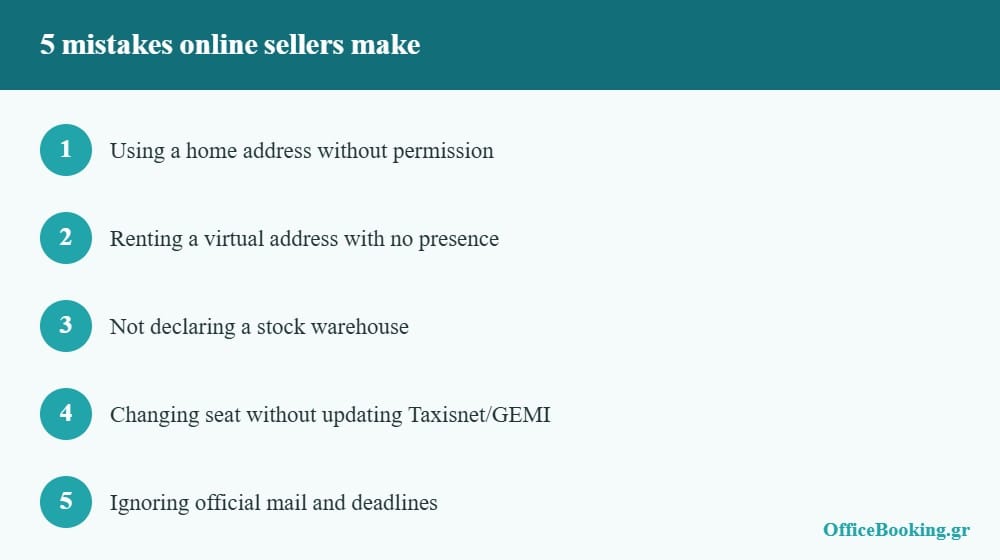
Physical registered office vs virtual address: what an inspector verifies

Dropshipping Registered Office in Greece: Smart 2026 Guide

Guides

If you run a dropshipping business and are setting it up in Greece, you need a dropshipping registered office in Greece that can survive scrutiny from the tax authority (AADE). E-commerce businesses process a high volume of transactions, which makes them a common focus for audits -and a shaky registered seat is one of the fastest ways to put your tax number at risk.

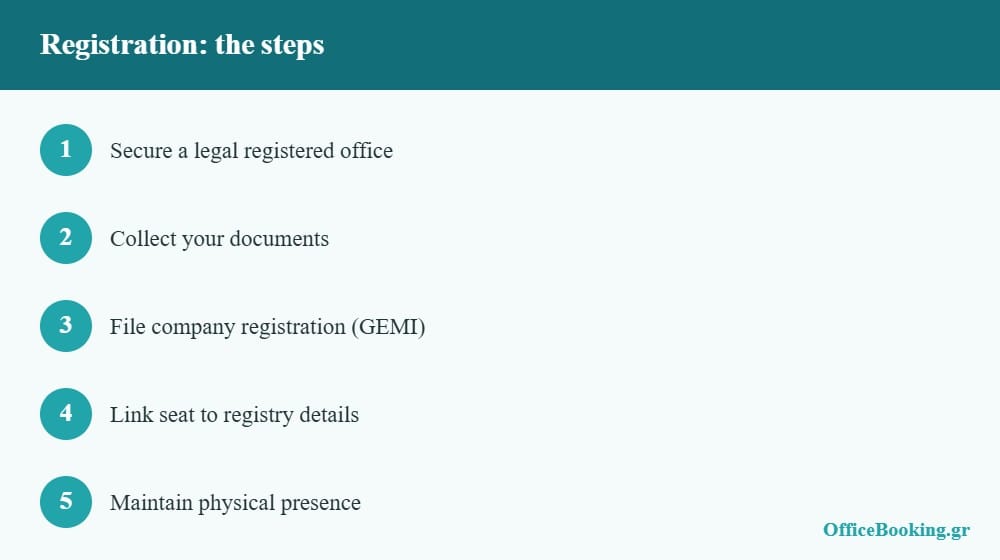
This guide covers exactly what an audit-proof registered office greece dropshipping business needs -in other words, what a dropshipping registered office in Greece needs to include, how much it should realistically cost, and how to get one active in about 24 hours.

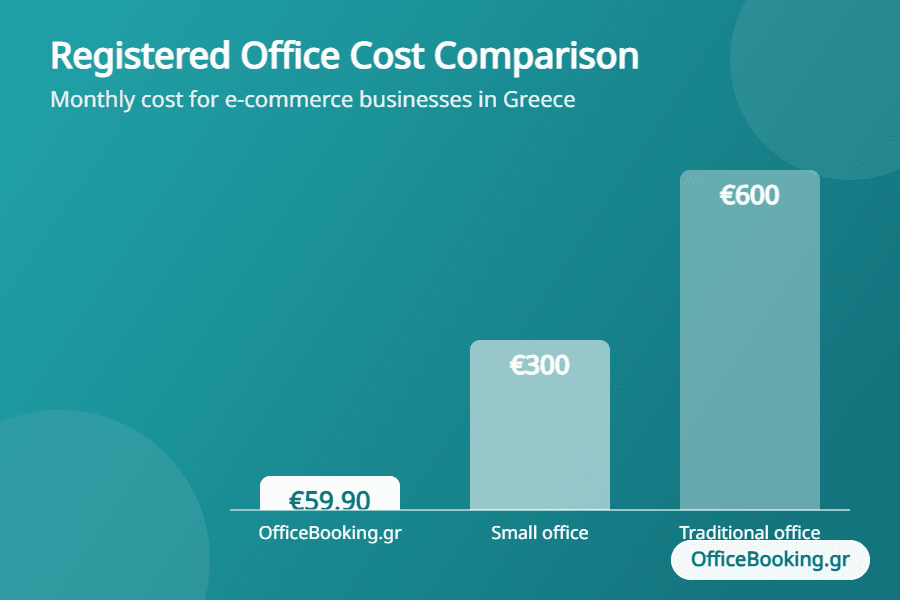
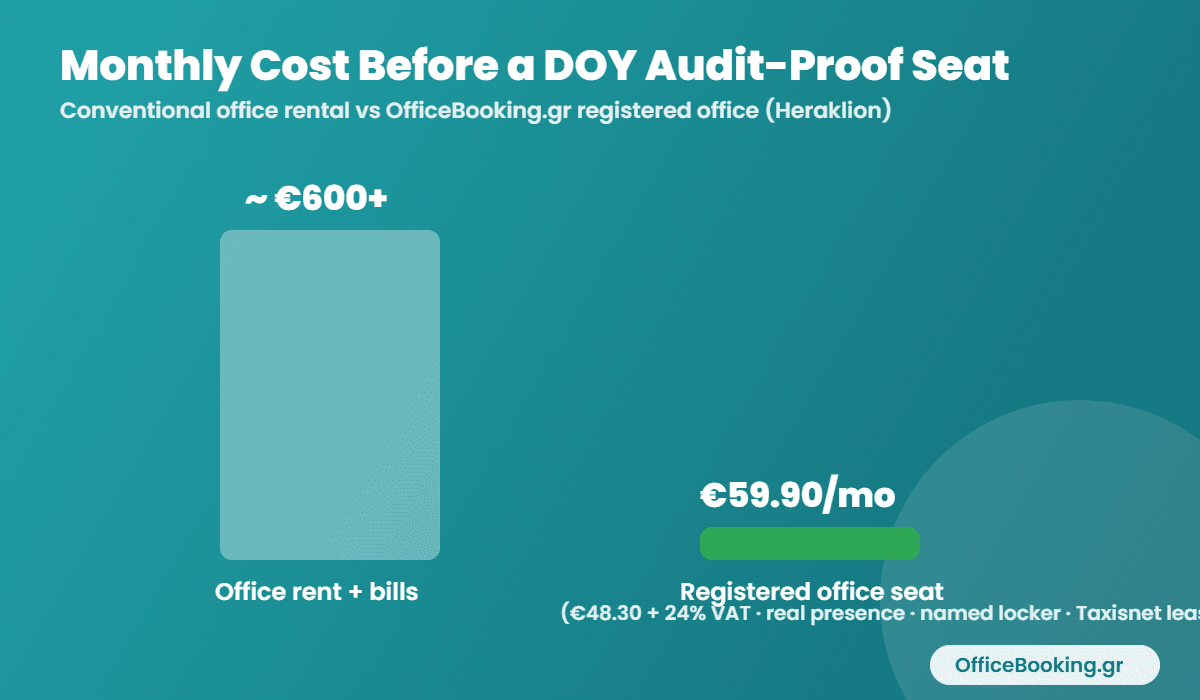
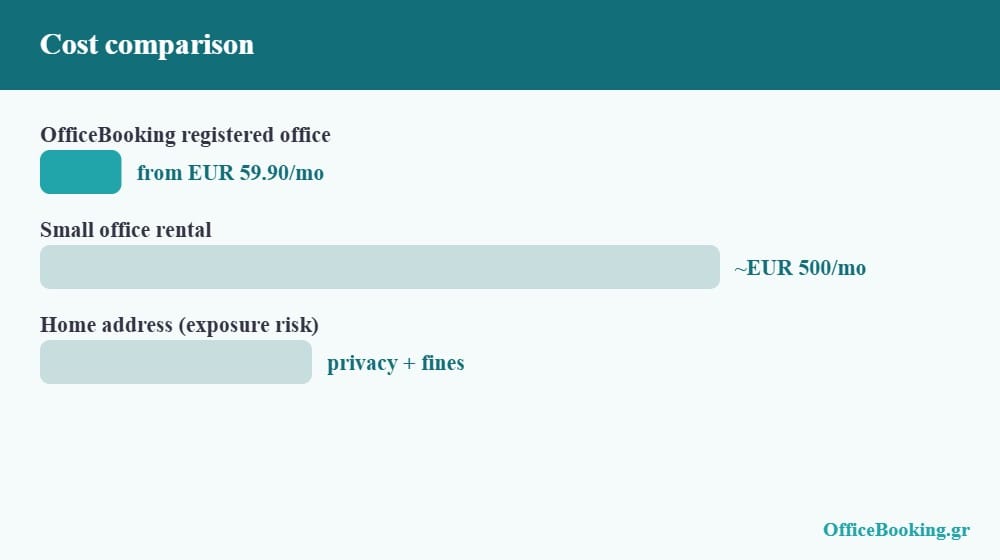
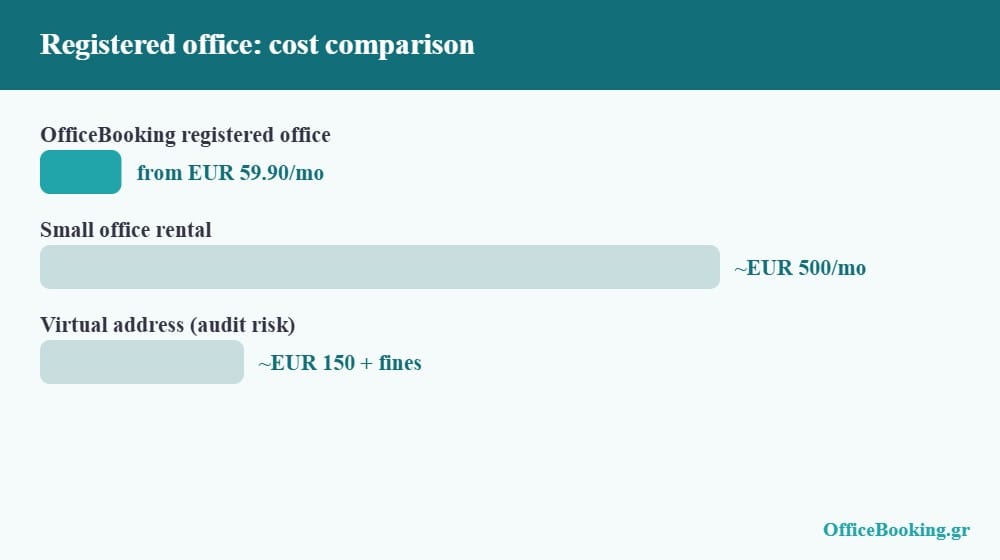
dropshipping registered office in Greece cost comparison


Why Dropshipping Businesses Need a Real Registered Office

Dropshipping runs on thin margins and low overhead, which is exactly why so many founders are tempted to use a home address or a bare mailbox as their registered seat. The problem is that a dropshipping registered office in Greece gets extra attention precisely because of high order volume and frequent supplier/customer invoicing. A registered seat that cannot prove genuine physical presence during a DOY audit (αυτοψία) puts your ΑΦΜ at direct risk of suspension.

For the company formation steps themselves -GEMI registration, tax numbers, VAT- we recommend a licensed accountant. What we provide is the one piece every dropshipping business needs regardless of legal structure: a real, compliant registered office.


What a DOY Audit Checks for E-commerce Businesses

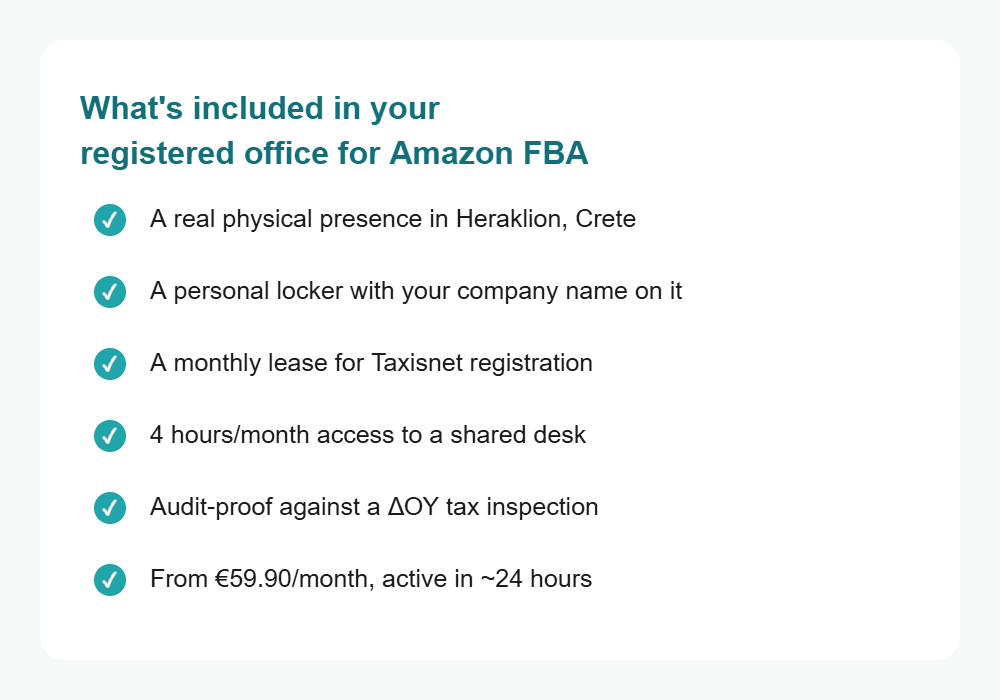
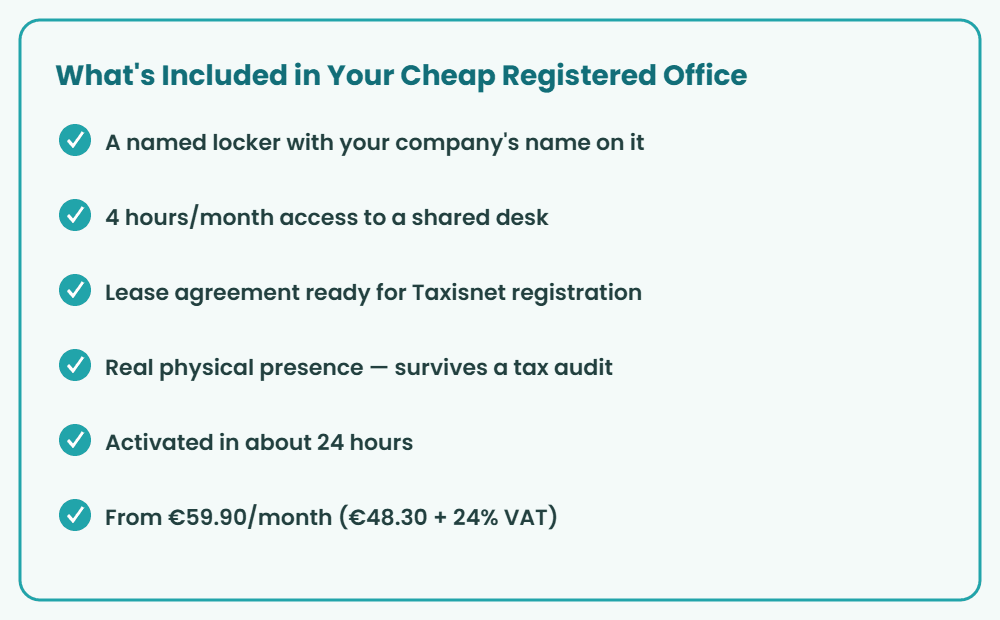
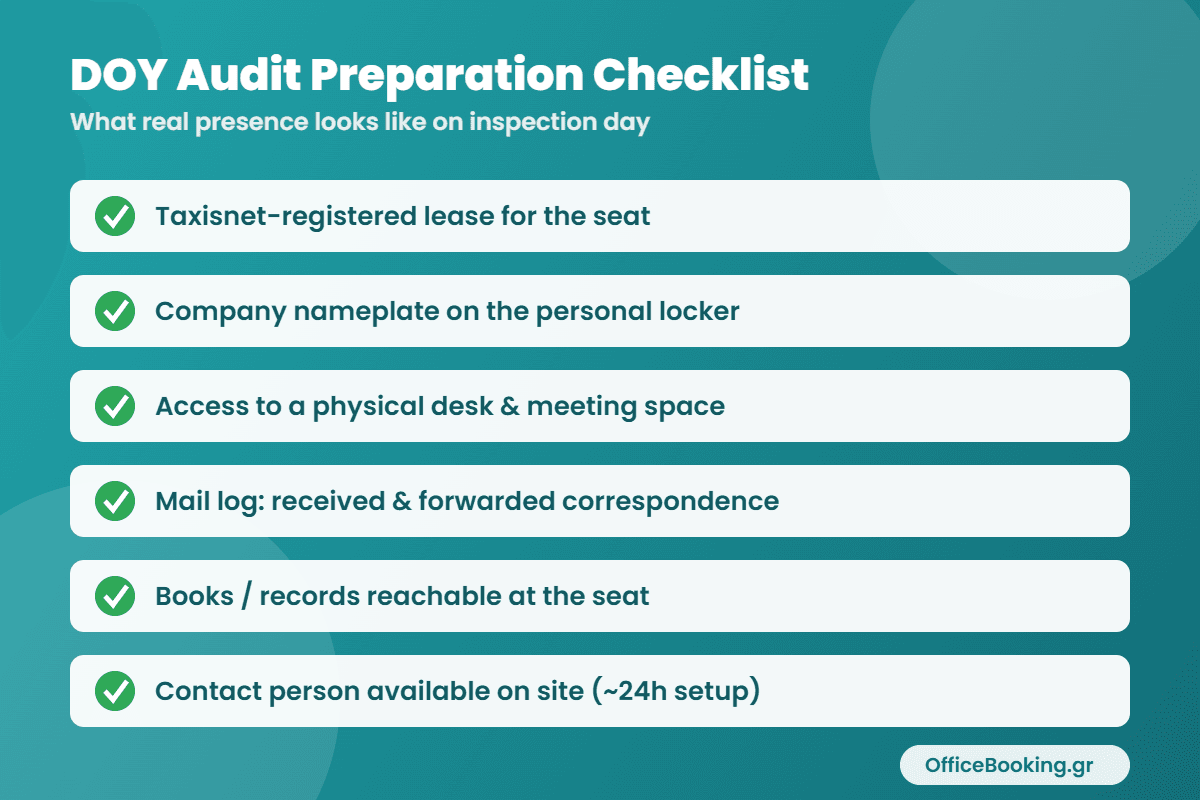
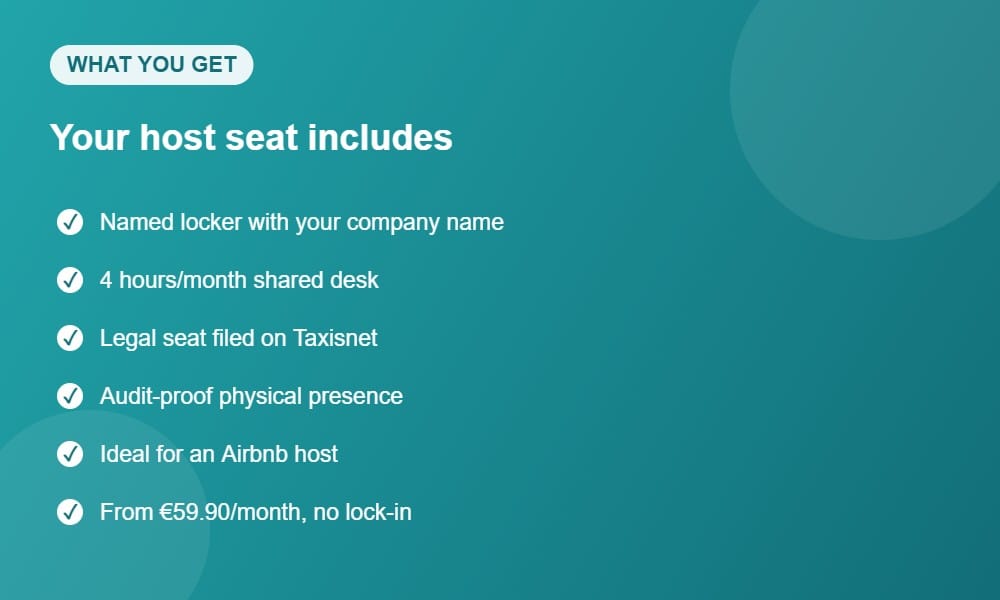
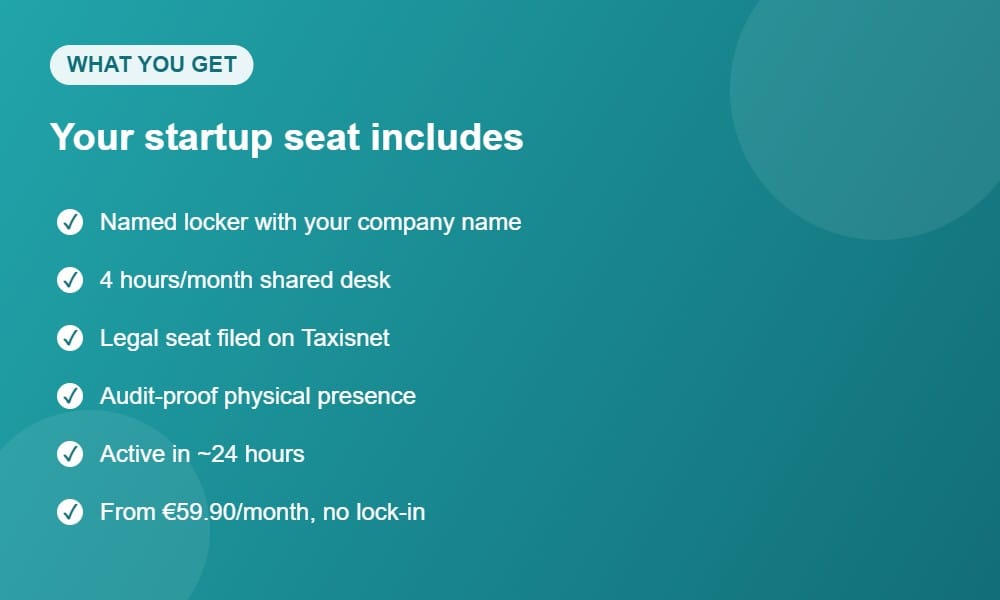
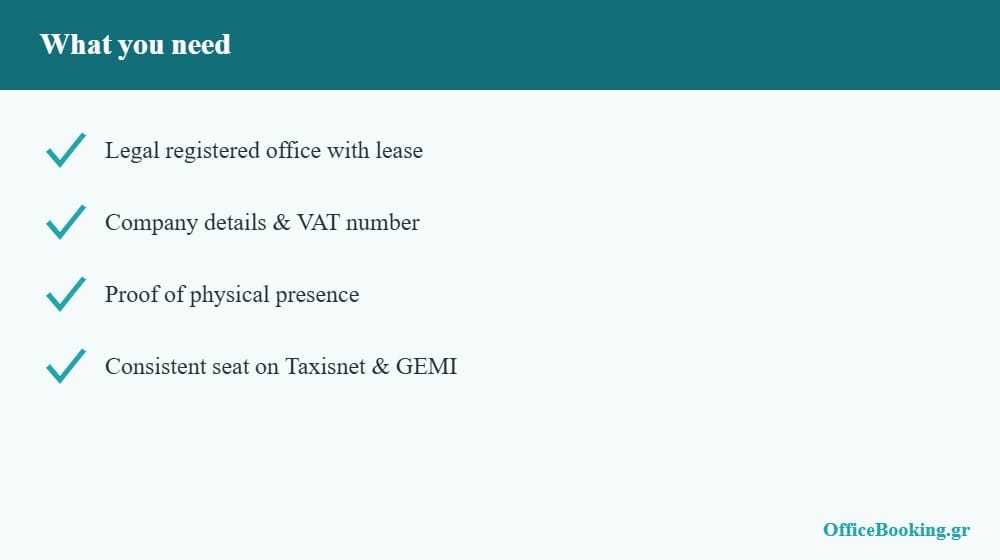
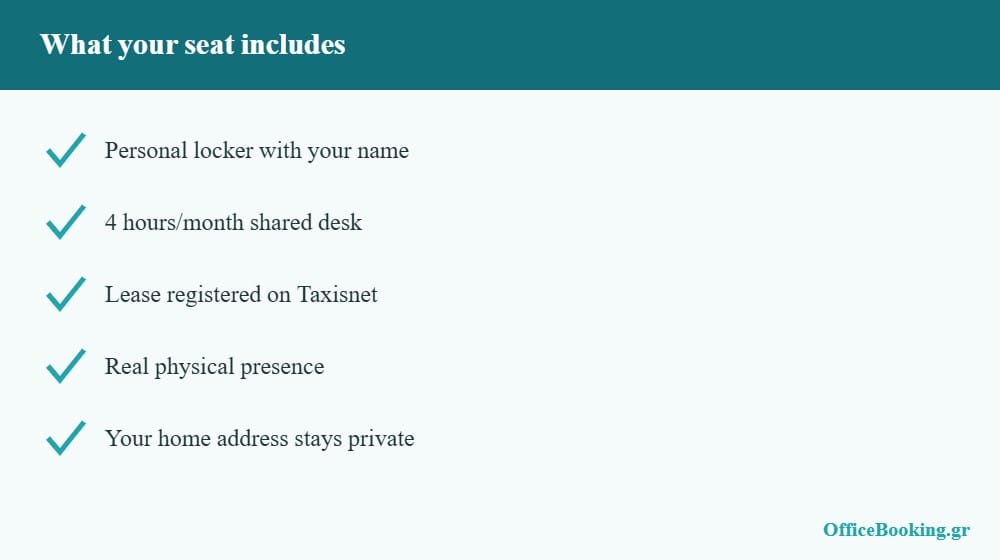
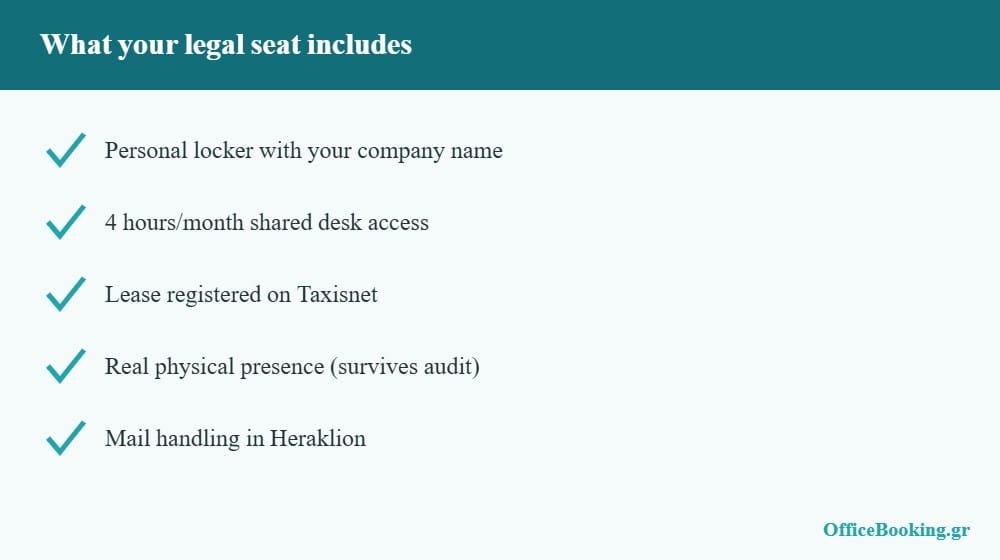
Tax inspectors verify that your registered seat is a genuine, identifiable business presence -not just an address on an invoice. With OfficeBooking.gr, your dropshipping registered office in Greece includes:

  • A real, named locker bearing your company name
  • A lease agreement registered on Taxisnet in your name
  • Access to a shared desk for 4 hours per month at Anaxagora 23, Heraklion, Crete
  • Genuine physical presence that passes inspection, with no surprises

You can review the official requirements directly from AADE. For questions about your specific setup, contact us.

dropshipping registered office in Greece audit checklist


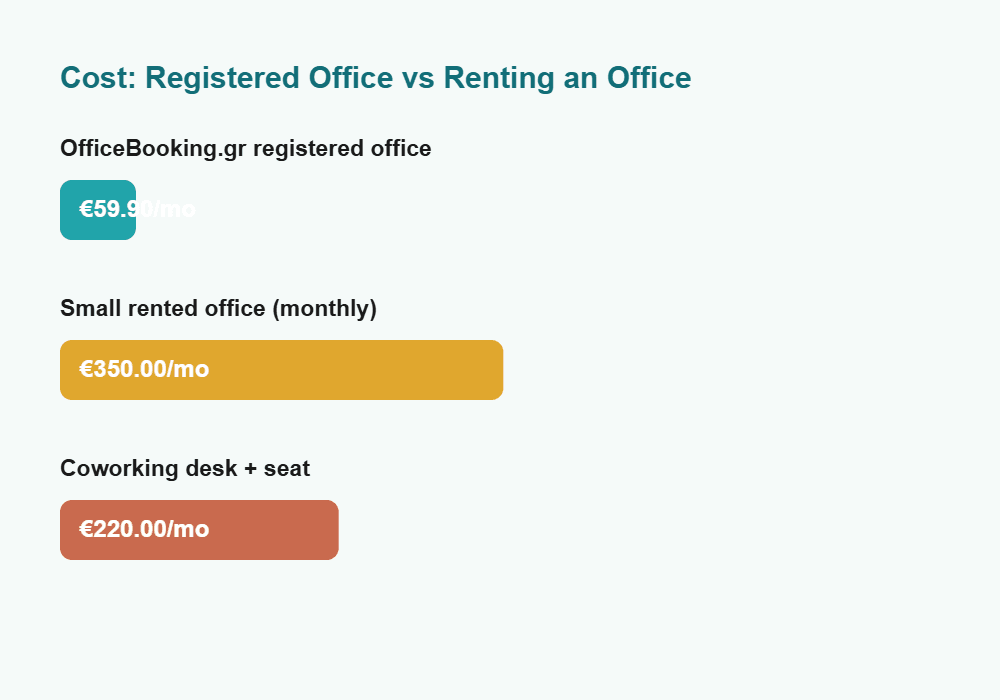
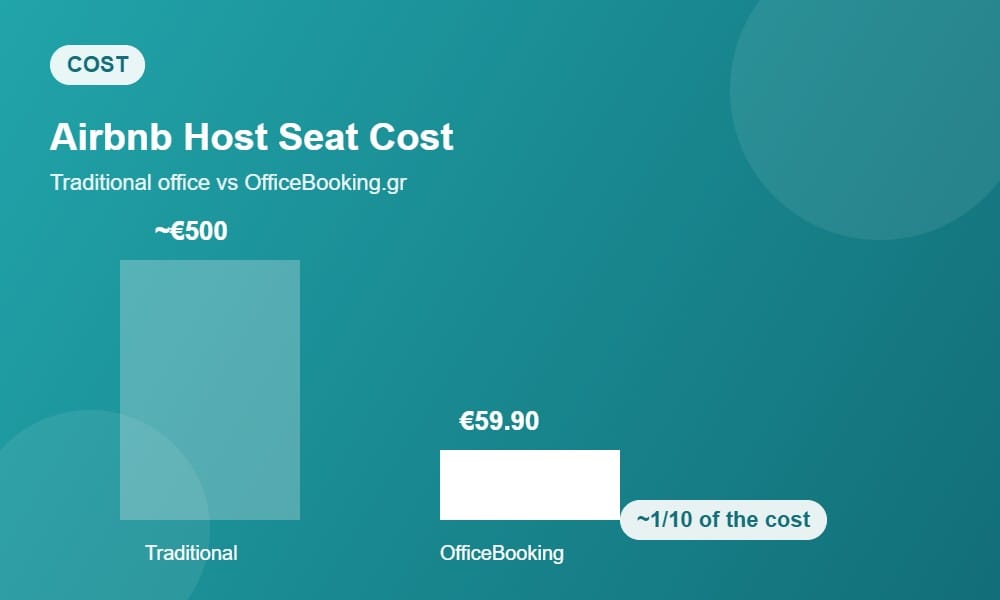
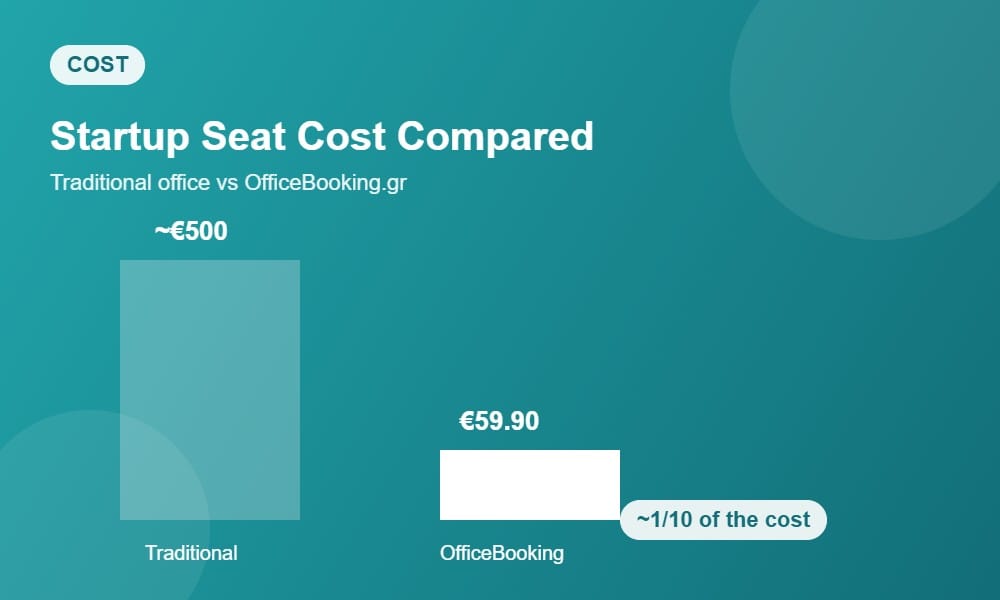
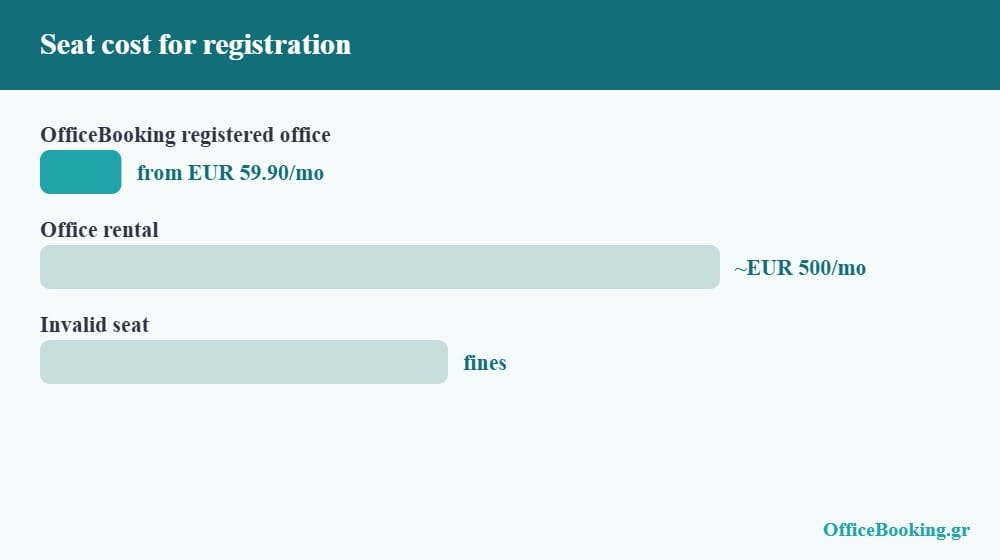
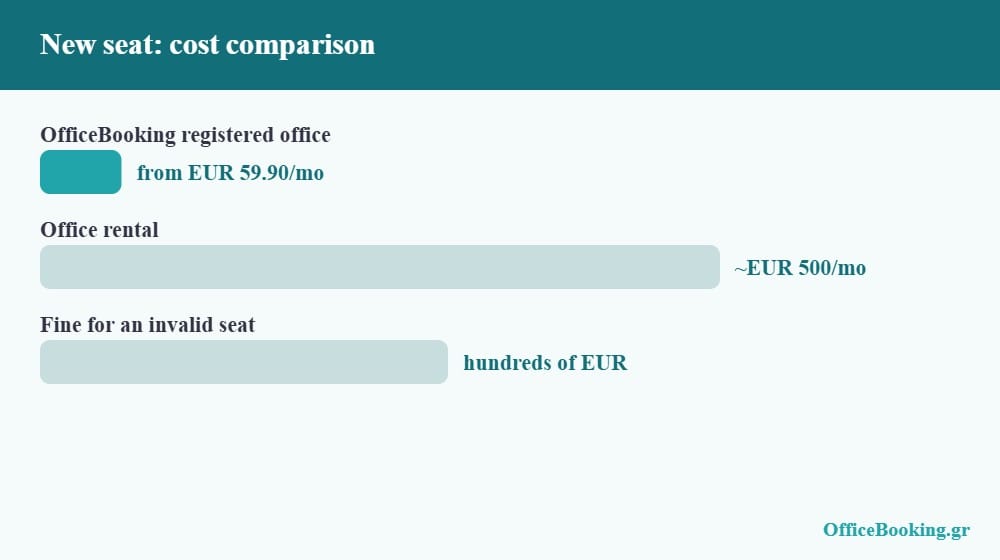
Cost Comparison: Dropshipping Registered Office vs Traditional Office

CriteriaTraditional OfficeOfficeBooking.gr
Monthly cost€300-€600+€59.90
ContractUsually 1-3 yearsMonthly, no lock-in
Survives a DOY auditYes, but expensiveYes, at 1/10th the cost
Activation timeWeeks~24 hours

See what’s included on our virtual office and business address page.


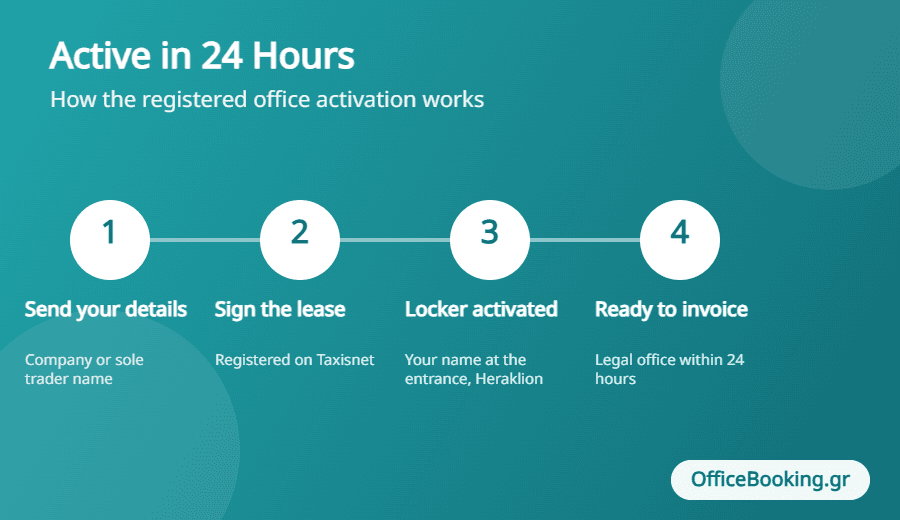
Realistic Timeline: How Fast You Get Set Up

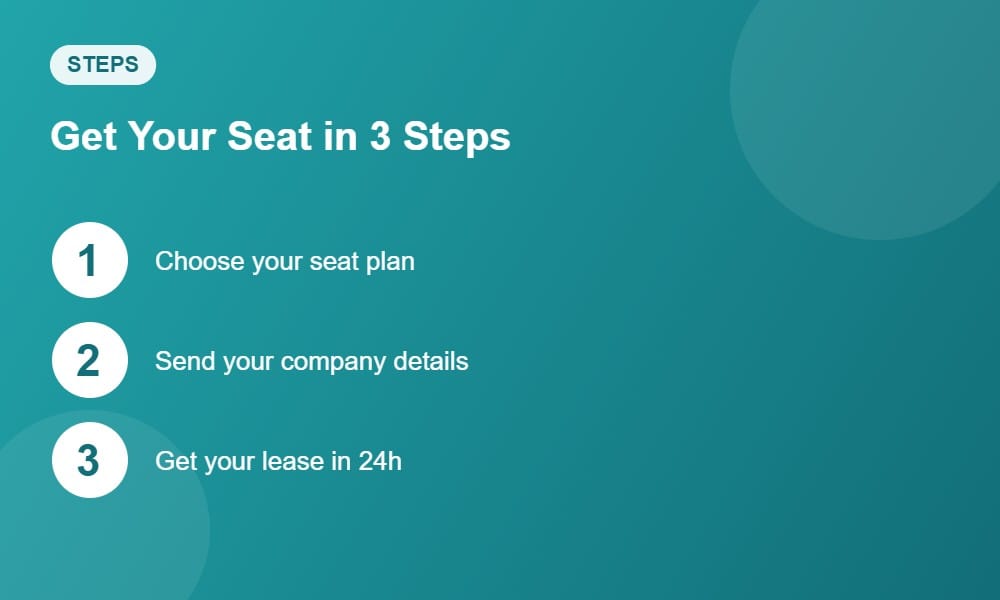
Hour 0-1: Choose your plan

Sign up online for the €59.90/month plan and provide your dropshipping business details.

Hour 1-12: Lease preparation

Our team prepares your lease agreement, ready for registration on Taxisnet.

Hour 12-24: Activation

Your dropshipping registered office in Greece is active -ready for GEMI registration or a seat change.


Who Needs This Most

New dropshippers just starting out

Getting your registered seat right from day one avoids future problems with ΔΟΥ and ΓΕΜΗ as your store scales.

Dropshippers with growing order volume

The larger your transaction volume, the more likely you are to attract audit attention. A genuinely inspection-ready seat protects your tax number.

Dropshippers currently using a home address

If you are running your store from your personal address, you are exposing that address publicly on GEMI, invoices, and your storefront -something a dedicated dropshipping registered office in Greece avoids entirely.


5 Mistakes Dropshippers Make With Their Registered Office

Mistake 1: Using a home address without checking insurance

Many residential policies exclude commercial activity, which can void coverage in the event of a claim.

Mistake 2: Relying on a mail-forwarding address alone

A mailbox with no real physical space behind it is one of the most common reasons a registered seat fails inspection.

Mistake 3: Overpaying for a traditional office “to be safe”

You do not need to pay hundreds of euros a month for legitimacy. A properly structured dropshipping registered office in Greece offers the same legal standing for €59.90/month.

Mistake 4: Forgetting to update the seat after moving

An outdated address creates a mismatch that can raise questions in an audit.

Mistake 5: Delaying the switch

The longer you operate with a shaky seat, the higher the risk. Switching takes about 24 hours, so there is little reason to wait.


Checklist: 5 Questions Before You Choose a Seat for Your Dropshipping Store

1. Does it survive a DOY audit?

Confirm there is a real, named space behind the address -not just a printed address.

2. What does it cost over 12 months?

Compare the annual cost of a dropshipping registered office in Greece against a traditional lease.

3. How fast does it activate?

If you want to launch quickly, you need a solution that activates in hours, not weeks.

4. Is there a long-term contract?

Monthly subscriptions without lock-in give you flexibility as your store grows or changes.

5. Does it support future growth?

If you plan to convert to a company structure like an IKE later, a stable seat from the start makes that transition easier.


Registered Office vs Virtual Mailbox: Know the Difference

The term “virtual office” gets used loosely, which causes confusion for dropshipping founders comparing options. A pure virtual mailbox -just an address for mail, with no real space behind it- may be fine for correspondence but is risky as your official registered seat. A genuine dropshipping registered office in Greece sits between a full traditional office and a bare mailbox: a real locker, a registered Taxisnet lease, and physical desk access.

FeaturePure Virtual MailboxOfficeBooking.gr
Physical spaceNoneYes, named locker + desk access
Taxisnet leaseRarelyAlways included
Survives DOY auditUncertainYes
Monthly costVaries, often similar€59.90

See the full breakdown on our virtual office and business address page.

dropshipping registered office cost comparison Greece


Why Heraklion Is a Smart Base for a Dropshipping Business

Heraklion, Crete combines a lower cost of living with solid business infrastructure -a port, an airport, courier services, and easy connections across Greece and the EU. For a dropshipping registered office in Greece, that means straightforward handling of any physical mail, access to a local network of accountants, and a professional, recognizable address for banks, suppliers, and marketplaces.

The address at Anaxagora 23, Heraklion, Crete is not just a formality -it is the physical foundation that lets you confidently confirm you have a legitimate registered seat whenever a supplier, bank, or auditor asks.

registered office options in Heraklion Greece


What Our Dropshipping Clients Say After Switching

A reliable business address for dropshipping greece is what separates a home-based side project from a business suppliers and banks take seriously. Founders who move from a home address or a bare mailbox to a proper dropshipping registered office in Greece consistently report the same relief:

  • “I didn’t expect it to be active in a single day.”
  • “I no longer have to give out my home address to suppliers and customers.”
  • “It costs less than the hidden expenses I had running my store from home.”

Scaling Your Store Without Scaling Your Address Risk

As your dropshipping business grows -more SKUs, more marketplaces, higher order volume- the scrutiny on your registered seat grows with it. A home address that worked when you were a one-person operation can quickly become a liability once you are processing hundreds of orders a month. Planning ahead with a proper dropshipping registered office in Greece avoids a disruptive scramble later, letting you focus on growing your store instead of worrying about your next audit.

Legal Obligations: What We Cover, What Your Accountant Handles

OfficeBooking.gr provides exactly one thing extremely well: a legal, physical registered office. Your ΑΦΜ, business activity codes (ΚΑΔ) for dropshipping, VAT on cross-border sales, and income tax filings are the responsibility of your accountant. Pairing a genuine dropshipping registered office in Greece with proper accounting guidance is the safest foundation for your store in 2026.


Setting Up From Abroad: No Need to Visit Greece First

A significant share of our dropshipping clients never set foot in Greece before their registered office is active. The entire process -choosing a plan, submitting business details, and receiving your Taxisnet-registered lease- happens online. You do not need to be physically present to get a fully compliant dropshipping registered office in Greece. Once your accountant completes the GEMI and tax registration steps using that address, your store is legally anchored in Greece from day one, even if you only visit Heraklion occasionally to use your shared desk hours.


Registering a Dropshipping Business in Greece: The Short Version

If you are setting up from abroad, the general path is: choose a legal form (individual business or a company like an IKE), get a Greek tax number, register with GEMI, and open a business bank account. Every one of these steps requires you to declare a registered seat -which is exactly why a dropshipping registered office in Greece matters so early in the process. We strongly recommend working with a licensed accountant for the formation steps themselves; what we handle is the registered office piece that those steps depend on.


What Suppliers and Marketplaces Expect From Your Business Address

Many dropshipping suppliers, payment processors, and marketplaces require a verifiable business address before approving your account or releasing payouts. A dropshipping registered office in Greece that shows up correctly on GEMI and can be verified by a quick search gives you a smoother onboarding experience with suppliers and platforms than a residential address or an unverifiable mailbox.


Quick Answer

Do you need a dedicated dropshipping registered office in Greece? If you want to survive a DOY audit, protect your personal privacy, and look credible to suppliers, marketplaces, and banks, yes -and it does not have to mean an expensive traditional lease. A properly structured dropshipping registered office in Greece gives you full legal compliance at a fraction of the cost, activated in about 24 hours, with zero long-term contract risk.


Opening a Business Bank Account With a Dropshipping Registered Office

Greek and EU banks generally require a registered business address to open a company account. Banks increasingly scrutinize addresses that look like bare mailboxes, especially for e-commerce accounts with international transaction patterns typical of dropshipping. Presenting a dropshipping registered office in Greece with a real lease on Taxisnet, rather than a home address or an unverifiable mailbox, tends to make this step noticeably smoother.


Different Dropshipping Models, Same Seat Requirement

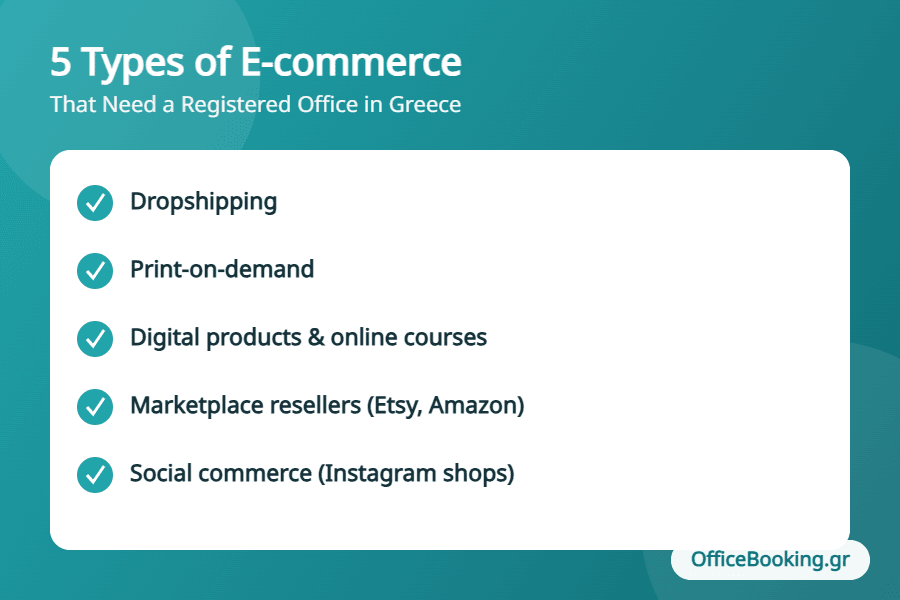
Whether you run a Shopify store sourcing from AliExpress, a print-on-demand business, or a niche store working with EU-based suppliers, the underlying legal requirement is the same: a genuine registered seat that can withstand scrutiny. The specifics of your supply chain do not change what a dropshipping registered office in Greece needs to provide -a real, inspection-ready address backed by a Taxisnet lease.

Shopify and AliExpress-based stores

High order volume and frequent cross-border invoicing make a verifiable seat especially important for this model.

Print-on-demand businesses

Even with fewer physical goods changing hands directly, your registered seat still needs to meet the same audit standard.

EU-supplier dropshipping stores

Intra-EU VAT considerations add another reason to keep your registered office and your accounting cleanly documented together.

Frequently Asked Questions

Is OfficeBooking.gr accepted by the Greek tax office for dropshipping businesses?

Yes. It is a genuine physical address with a named locker and a lease registered on Taxisnet, built to survive a DOY audit.

How much does a dropshipping registered office in Greece cost?

From €59.90/month (€48.30 + 24% VAT), roughly 1/10th the cost of a traditional office lease.

How long does activation take?

Approximately 24 hours from signup.

Can I use this for a dropshipping store that sells across the EU?

Yes -your dropshipping registered office in Greece covers your legal seat regardless of where your customers or suppliers are located. VAT specifics for cross-border sales should be confirmed with your accountant.

Do I need a separate address if I sell through multiple marketplaces?

No, one dropshipping registered office in Greece covers all sales channels of the same business. See our full FAQ page or get in touch with questions.


Bottom Line for Dropshipping Founders

A dropshipping registered office in Greece is one of the few compliance decisions that is genuinely easy to get right the first time. Instead of gambling on a home address or a bare mailbox, a properly structured registered office costs a small fraction of a traditional lease, activates in about 24 hours, and gives you a defensible answer the moment a supplier, bank, or tax auditor asks where your business is actually based.

What happens if I already declared my home address and want to switch?

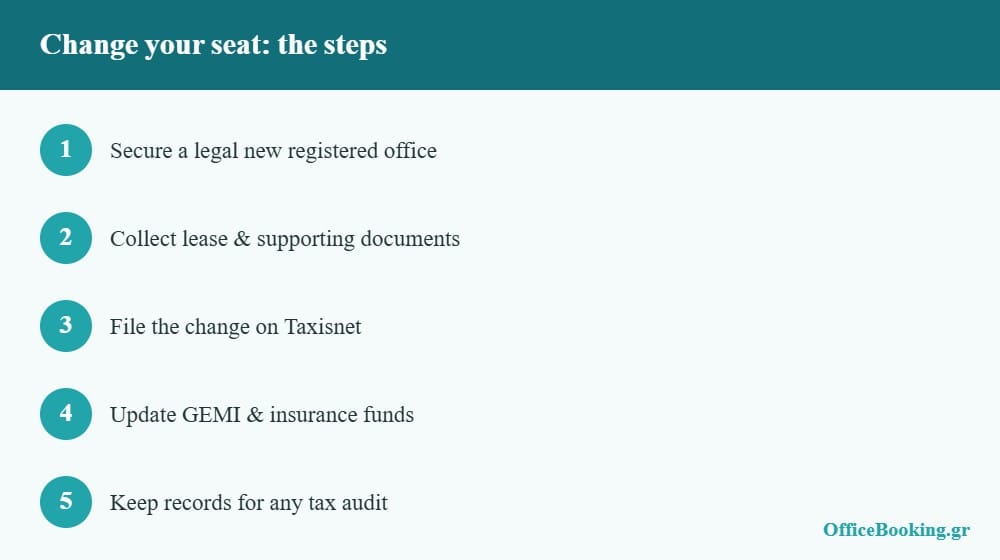
You can change your registered seat (μεταβολή έδρας) at any time. Once your dropshipping registered office in Greece is active, your accountant files the change with Taxisnet and GEMI on your behalf -typically a straightforward update, not a full re-registration.

Does a dropshipping registered office in Greece affect my VAT rate?

The address itself does not change your VAT obligations. Cross-border and intra-EU VAT rules depend on where your customers and suppliers are located, so always confirm the specifics with your accountant.


Insurance and Liability: Why the Home-Address Shortcut Backfires

Beyond the audit risk, using your home as a registered seat can create liability gaps most dropshippers never think about until something goes wrong. If a customer dispute, product liability claim, or tax dispute escalates, having your registered seat tied to your home address blurs the line between your personal and business liability in ways that can complicate both insurance claims and legal proceedings. A dedicated dropshipping registered office in Greece keeps that separation clean, which is one more reason experienced dropshippers treat it as a foundational decision rather than an afterthought.

Conclusion: Protect Your Store From Day One

A dropshipping registered office in Greece is not a box to check once and forget -it is the foundation your entire business stands on. A home address or a bare mailbox might work for a while, but the moment AADE looks closer, an unverifiable seat can cost far more than €59.90/month in fines, stress, and lost time. A genuine, audit-proof registered office in Heraklion gives your dropshipping store the legal footing to scale with confidence.

Ready to protect your store? Get started with OfficeBooking.gr today.

Read More
Physical registered office cost vs virtual address and office rental in Greece

Do I Need a Physical Office in Greece? Smart 2026 Guide

Guides

If you are launching an e-shop, freelancing, or setting up a dropshipping business in Greece, you have probably asked yourself: do I need a physical office in Greece, or can I just use my home address? The honest answer in 2026 is that using your home address is legally possible, but it carries real risk once the AADE (Greek tax authority) starts checking who is actually running a business from where.

Before we go further: do I need a physical office in Greece in every case? Not always in theory, but almost always in practice once AADE starts checking. This guide breaks down exactly when you do need a physical office in Greece, what a tax audit actually looks for, and how to get a fully legal, audit-proof registered office without paying for a traditional lease.

Quick Answer

Do I need a physical office in Greece? If you want your registered seat to survive a DOY audit, yes -you need a genuine, verifiable physical address, though it does not have to be an expensive traditional office. A compliant registered office like OfficeBooking.gr answers the question “do I need a physical office in Greece” for €59.90/month, active in about 24 hours.


Do I Need a Physical Office in Greece? The Short Answer

Every company and individual business (ατομική επιχείρηση) registered in Greece must declare a registered seat (φορολογική έδρα) with the tax office and GEMI. So technically, you always need an address. The real question is whether that address needs to be a real, verifiable physical space -and increasingly, the answer is yes. If you do need a physical office in Greece that can survive an inspection, a home address alone is often not enough, especially for e-shop and dropshipping businesses with growing order volumes.

do I need a physical office in Greece - cost options compared

For company formation itself -GEMI registration, tax numbers, VAT- we recommend working with a licensed accountant. What we provide is the piece every business needs regardless of legal form: a real, compliant registered office.


The Home-Address Trap for E-shop & Dropshipping Founders

Using your home address as your registered seat seems free, but it comes with hidden costs and risks:

  • Your home insurance may not cover commercial activity, which can void your policy in case of a claim
  • Your personal address becomes public on GEMI, invoices, and your website
  • If a tax auditor visits and finds no real business presence, you risk fines or suspension of your tax number (ΑΦΜ)
  • It does not scale as your e-shop or dropshipping business grows

This is exactly why so many foreign founders ask themselves if they do need a physical office in Greece before it becomes a compliance problem, not after.


What a DOY Audit Actually Checks

A DOY (tax office) audit -called αυτοψία in Greek- can happen without much warning. Inspectors verify that a registered seat is a genuine, identifiable business presence, not just an address on paper. With OfficeBooking.gr you get:

  • A real, named locker bearing your company name
  • A lease agreement registered on Taxisnet in your name
  • Access to a shared desk for 4 hours per month at Anaxagora 23, Heraklion, Crete
  • A genuine physical presence that passes inspection, with no surprises

DOY audit checklist for a registered office in Greece

You can review the official requirements directly from AADE. If you want to talk through your specific situation, contact us and we will walk you through it.


physical office in Greece vs home address inspection comparison

Real Cost Comparison: Home Address vs Registered Office vs Traditional Office

CriteriaHome AddressOfficeBooking.grTraditional Office
Monthly costAppears free (hidden risk)€59.90€300-€600+
Survives a DOY auditOften notYes, 100%Yes, but expensive
Privacy of home addressExposed publiclyProtected, separate addressProtected
Activation timeImmediate, but risky~24 hoursWeeks
Contract commitmentNoneMonthly, no lock-inUsually 1-3 years

Learn more about what is included on our virtual office and business address page.


Home Address Business Registration Greece: Why Founders Switch

Many foreign founders start with home address business registration in Greece because it feels simple when they first arrive. But as the business grows -more invoices, more visibility, more scrutiny- most switch to a dedicated registered office. The reasons are consistent: privacy, professional credibility with banks and partners, and peace of mind that the seat will hold up under a tax audit.


E-shop Registered Office Greece: What E-commerce Founders Need to Know

An e-shop registered office in Greece gets extra scrutiny because online businesses process higher transaction volumes and are a known focus area for AADE audits. A registered office that cannot prove genuine physical presence is a direct risk to your tax number. OfficeBooking.gr was built specifically to give e-shop and dropshipping founders a real, inspection-ready address without the overhead of renting commercial space.


How Fast You Can Get Set Up: A Realistic Timeline

Hour 0-1: Choose your plan

Sign up online for the €59.90/month plan and provide your business details.

Hour 1-12: Lease preparation

Our team prepares your lease agreement, ready for registration on Taxisnet.

Hour 12-24: Activation

Your registered office at Anaxagora 23, Heraklion, Crete is active -ready for your GEMI registration or seat change (μεταβολή έδρας).


Who Needs This Most

Foreign founders registering remotely

If you are setting up a Greek company from abroad, a verified physical address is often required by banks and partners -and it answers the question of whether you do need a physical office in Greece before you even ask a lawyer.

E-shop and dropshipping owners

Higher transaction volume means higher audit attention. An e-shop registered office in Greece that is genuinely inspection-ready protects your tax number.

Digital nomads and expats

If you move frequently, a stable registered office that does not depend on your current rental address keeps your business compliant no matter where you personally live.


Checklist: 6 Questions Before You Register From Home

1. Do I need a physical office in Greece if inspectors could visit my home?

A DOY audit can happen with little notice. Is your home address ready for that?

2. Do you want your personal address to be public?

Your registered seat appears on GEMI, invoices, and your website footer.

3. Does your home insurance cover commercial activity?

Many residential policies exclude business use, which can void coverage in a claim.

4. Will your business grow beyond a single-person operation?

A home address does not scale. A dedicated registered office does.

5. How much is the risk of a failed audit actually worth?

Compare potential fines and tax number suspension against €59.90/month for a genuine, legal seat.

6. Do you need the seat active quickly?

OfficeBooking.gr activates in about 24 hours, versus weeks for a traditional lease.


What Counts as a Legal Registered Office in Greece (Answering “Do I Need a Physical Office in Greece”)

Not every address labeled “virtual office” is treated equally by the tax authority. To count as a legal registered seat that can survive scrutiny, an address generally needs to show:

  • A real, physical location that can be visited
  • A named space (like a locker) identifiable with your business
  • A lease agreement properly registered on Taxisnet
  • Some form of genuine access, not just a mailbox

This is the difference between a purely virtual address and a true registered office. If you have wondered whether you do need a physical office in Greece versus a simple mail-forwarding service, the honest answer is that mail-forwarding alone rarely survives an audit.


5 Common Mistakes Foreign Founders Make

Mistake 1: Assuming a virtual mailbox is enough

A PO box or mail-forwarding address with no real physical space behind it is a common reason registered offices fail inspection.

Mistake 2: Using a home address without checking insurance

Many residential insurance policies exclude commercial activity, which can leave you exposed.

Mistake 3: Overpaying for a traditional office “just to be safe”

You do not need to pay hundreds of euros a month for legitimacy -a properly structured registered office at €59.90/month offers the same legal standing.

Mistake 4: Forgetting to update the seat after moving

If your personal address changes but your registered seat is not updated, you create a mismatch that can trigger questions during an audit.

Mistake 5: Delaying the decision

The longer you operate with a shaky registered seat, the higher the risk. Switching to a compliant registered office takes about 24 hours, so there is little reason to wait.


Why Heraklion Is a Smart Base for Your Registered Office

Heraklion, Crete combines a lower cost of living with solid business infrastructure -a port, an airport, courier services, and easy connections across Greece and the EU. For a registered office, that means:

  • Straightforward handling of any physical mail or documents
  • Access to a local network of accountants and legal professionals
  • A professional, recognizable address for banks and business partners

The address at Anaxagora 23, Heraklion, Crete is not just a formality -it is the physical foundation that lets you confidently answer “yes” when someone asks whether you have a legitimate registered office in Greece.


What Our Clients Say After Switching

Founders who move from a home address or a bare-bones virtual mailbox to a proper registered office consistently report the same relief:

  • “I didn’t expect it to be active in a single day.”
  • “I no longer have to give out my home address to clients and suppliers.”
  • “It costs less than the hidden expenses I had with my home address setup.”

Legal Obligations: What We Cover, What Your Accountant Handles

OfficeBooking.gr provides exactly one thing extremely well: a legal, physical registered office. Matters like your tax number (ΑΦΜ), business activity codes (ΚΑΔ), VAT registration, and income tax filings are the responsibility of your accountant or lawyer. Pairing a genuine registered office with proper accounting guidance is the safest foundation for your business in 2026.


Registering a Company in Greece as a Foreigner: The Short Version

If you are setting up from abroad, the general path is: choose a legal form (individual business or company like an IKE), get a Greek tax number, register with GEMI, and open a business bank account. Every one of these steps requires you to declare a registered seat -which is exactly why the question “do I need a physical office in Greece” comes up so early in the process. We strongly recommend working with a licensed accountant for the formation steps themselves; what we handle is the registered office piece that those steps depend on.


registered office cost comparison for e-shop registered office Greece

Registered Office vs Virtual Office: Know the Difference

The term “virtual office” is used loosely in Greece, and that causes confusion. A pure virtual office -just a mailing address with no real space- may be fine for correspondence but is risky as your official registered seat. OfficeBooking.gr sits in between a full traditional office and a bare virtual mailbox: you get a real locker, a registered Taxisnet lease, and physical desk access, which is what actually matters when someone asks whether your business needs a physical office in Greece to stay compliant.

FeaturePure Virtual MailboxOfficeBooking.gr
Physical spaceNoneYes, named locker + desk access
Taxisnet leaseRarelyAlways included
Survives DOY auditUncertainYes
Monthly costVaries, often similar€59.90

See the full breakdown on our virtual office and business address page.


Scaling Beyond a Single Founder

As your e-shop or dropshipping business grows, so does the scrutiny on your registered seat. A home address that worked when you were a one-person operation can quickly become a liability once you have employees, a warehouse partner, or a significantly higher transaction volume. Planning ahead with a proper registered office avoids a disruptive scramble later, and it is one less thing to worry about as you focus on growing your business.


Remote Founders: Setting This Up Without Visiting Greece

To directly recap: do I need a physical office in Greece if I run my business remotely? A significant share of our clients never set foot in Greece before their registered office is active. The entire process -choosing a plan, submitting business details, and receiving your Taxisnet-registered lease- happens online. This matters if you are asking whether you do need a physical office in Greece while still living abroad: you do not need to be physically present to get a fully compliant, audit-ready seat. Once your accountant completes the GEMI and tax registration steps using that address, your business is legally anchored in Greece from day one, even if you visit Heraklion only occasionally to use your shared desk hours.

Frequently Asked Questions

Do I need a physical office in Greece to register a company?

Yes, every registered business needs a declared seat. It does not need to be a full traditional office -a compliant registered office like OfficeBooking.gr satisfies the legal requirement at a fraction of the cost.

Is OfficeBooking.gr accepted by the Greek tax office?

Yes. It is a genuine physical address with a named locker and a lease registered on Taxisnet, built to survive a DOY audit.

How much does an e-shop registered office in Greece cost?

From €59.90/month (€48.30 + 24% VAT), roughly 1/10th the cost of a traditional office lease.

How long does activation take?

Approximately 24 hours from signup.

Can I use this instead of home address business registration in Greece?

Yes -that is exactly the use case. You get a professional, audit-ready address instead of exposing your personal home address.

For more, see our full FAQ page or get in touch.


What is the difference between a registered office and home address business registration in Greece?

A registered office is a dedicated, verifiable business address separate from where you live, built to withstand a tax audit. Home address business registration in Greece uses your personal residence instead, which exposes your privacy and carries more audit risk.

Is this suitable for an e-shop registered office in Greece specifically?

Yes. E-commerce businesses are a common audit focus because of transaction volume, so having a genuine, inspection-ready e-shop registered office in Greece is particularly valuable.


So, Do I Need a Physical Office in Greece? Recap

So, do you need a physical office in Greece? If you want your business to survive a DOY audit, protect your personal privacy, and look credible to banks, partners, and customers, the answer is effectively yes -but it does not have to mean an expensive traditional lease. A properly structured registered office gives you full legal compliance at a fraction of the cost, activated in about 24 hours, with zero long-term contract risk.

Conclusion: Make the Safe Choice From Day One

The question “do I need a physical office in Greece” is really a question about risk tolerance. A home address might work for a while, but the moment AADE takes a closer look, an unverifiable seat can cost you far more than €59.90/month in fines, stress, and lost time. A genuine, audit-proof registered office in Heraklion gives you the legal footing to grow your e-shop, dropshipping business, or freelance practice with confidence.

If you were still asking “do I need a physical office in Greece” when you started reading, the answer is now clear. Ready to set up your registered office the right way? Get started with OfficeBooking.gr today.

Read More

Registered Office Cost Greece 2026: Smart Cheap Guide

Guides

The registered office cost greece question is one of the first things foreign founders ask in 2026, and the answer almost always hides a trap: the heaviest expense is not the formation fees, it is the registered office (the legal seat). This guide breaks down transparently what it really costs to run a company seat in Greece and how to cut your biggest recurring bill.

Let us be clear from the start: one mandatory step of any company registration is a legal registered office, and that is exactly what OfficeBooking.gr provides, with a real physical presence from €59.90/month. Everything else (VAT number, activity codes, accounting) is the frame around this decision, not its centre.

For the paperwork outside our scope, talk to your accountant. Below you will find a cost breakdown, comparison tables, worked examples and an FAQ so you know exactly where your money goes.

registered office cost greece comparison banner

What is the real registered office cost greece in 2026?

The total registered office cost greece is not a single number. It is a mix of one-off formation fees (registry, GEMI, online incorporation) and recurring monthly costs that follow you for as long as the business operates. Most people only budget the one-off part and forget that the recurring seat cost decides viability.

One-off formation fees for a private company (IKE) typically range from a few dozen to a few hundred euros, depending on whether you file yourself or delegate. The recurring item, and especially the seat, is where money is lost or saved every single month.

So when you compare offers, do not stop at the headline setup fee. Ask what you will pay every month afterwards. That is where the true registered office cost greece hides over time.

What drives the registered office cost greece?

The final figure is shaped by a few factors: the legal form (IKE, AE, branch), whether you do the process alone or with an accountant, and above all the seat choice. The first two change one-off costs by a few hundred euros; the third changes your monthly cost for years.

An office at €400/month means €4,800 a year just for an address. A legal seat from €59.90/month means roughly €719 a year. That gap, multiplied across the years you operate, is the single biggest lever on the registered office cost greece.

Formation expenses step by step (a quick map)

Below is a short map of the main expenses. This is not an exhaustive tutorial — for the details of each step, consult your accountant or lawyer.

Cost itemTypeIndicative amount
Online incorporation (e-YMS)One-off~€50–€60
GEMI registration & feeOne-off/annuala few dozen €
Registered office (rented office)Monthly€300–€600+
Registered office (OfficeBooking)Monthlyfrom €59.90
Accounting supportMonthlyvariable

As you can see, the biggest difference in the final registered office cost greece does not come from the registry fees, but from the seat choice. That is where we focus next.

The hidden cost: the registered office (legal seat)

Every company in Greece needs a declared business seat on Taxisnet. Traditionally this meant renting an office, resulting in €300 to €600 or more per month, plus a deposit, utility bills and shared charges. For a freelancer, an e-shop owner or a remote founder, that money is pure waste.

OfficeBooking.gr offers a legal registered office with a real physical presence: a personal locker carrying your company name, plus 4 hours/month of shared desk, properly declared as your seat on Taxisnet. It is not a “virtual address” — it is a real space at Anaxagora 23, Heraklion, Crete.

This difference turns the heaviest part of the registered office cost greece from a permanent obligation of hundreds of euros into a small, predictable fixed cost.

Registered office cost greece vs office rent: the comparison

The clearest picture of the registered office cost greece appears when you place a rented office next to our solution side by side.

FactorRented officeOfficeBooking.gr
Monthly cost€300–€600+from €59.90
Deposit1–3 months rentnone
Utilities/chargesYesNo
Activation timeweeks~24 hours
Commitmentlong-termmonthly
Survives a DOY auditYesYes (physical presence)

In plain terms, a seat through OfficeBooking costs about 1/10 of an office, without sacrificing legality or the ability to withstand an on-site inspection. That is the biggest key to a low registered office cost greece.

Worked example: the registered office cost greece for a new IKE

Let us look at a realistic scenario for a foreign founder opening an IKE. One-off: ~€60 for online incorporation and a few dozen euros in GEMI fees. Seat cost: €59.90/month instead of €400 rent. Within the first year, from the seat alone, the saving exceeds €4,000.

If the same person chose a rented office, the first year would have added a deposit, utilities and shared charges. So the real registered office cost greece would be many times higher, before earning the first euro of revenue.

The conclusion is consistent: the variable you control most easily in the registered office cost greece is the seat — and that is where the difference is measured in thousands of euros.

Registered office cost greece for expats, e-shops & digital nomads

For a remote founder, an e-shop or a dropshipping business, there is no reason to pay for a physical office: the work happens online. Yet the seat remains mandatory. A low-cost legal registered office keeps the registered office cost greece sensible without pointless overhead.

For founders living abroad, the seat is often the hardest part, since they have no available space in Greece. A legal seat from €59.90/month solves exactly that, with no need to rent an office remotely. So the total cost stays low and predictable, wherever you live.

There is also a credibility bonus: a real address and company name on a named locker reassures clients, banks and suppliers far more than a bare “virtual” mailbox ever could.

Physical presence vs a virtual address

Many “cheap” options on the market are simply postal addresses with no real space. In a DOY tax audit (on-site inspection) this is dangerous: if there is no physical presence, the seat can be challenged and fines may follow. OfficeBooking.gr gives you a real, verifiable space that withstands an inspection.

In other words, the slightly cheaper “virtual” office can cost you many times more in penalties. Choosing the right seat is part of a healthy registered office cost greece, not just the cheapest line in your budget.

The audit-proof angle matters most for businesses with foreign suppliers or platforms, where a questioned seat can disrupt VAT and invoicing. A real space removes that risk entirely.

How to calculate your registered office cost greece step by step

To avoid vague estimates, calculate your own number in three simple steps. First, add up the one-offs: e-YMS online incorporation and GEMI fees. These are relatively fixed and small compared with the recurring costs.

Second, work out the annual seat cost. Multiply the monthly amount by 12. An office at €400 gives €4,800 a year; a seat at €59.90 gives roughly €719. The difference here is the core of the registered office cost greece on an annual basis.

Third, add the variable accounting fees. These depend on your turnover and transactions, so discuss them with your accountant. The sum of the three gives you a realistic, personal registered office cost greece, with no surprises.

A quick rule of thumb: the seat is the cost you can cut immediately by around 90%, while the registry fees barely change.

5 mistakes that inflate the registered office cost greece

In practice, most founders overpay because of avoidable mistakes. The most common are:

  • Renting an office they do not need — the largest share of a bloated fixed cost.
  • Choosing a “virtual” address with no physical presence — cheap today, expensive in an audit.
  • Long-term commitments that lock in a high cost for years.
  • Hidden charges (deposits, utilities) not shown in the headline price.
  • No comparison of offers before deciding on the seat.

Avoid these five and you noticeably lower the registered office cost greece without sacrificing anything that matters.

Cost by legal form (IKE vs AE vs branch)

The legal form affects the one-off costs, but the need for a seat is common to all. For the choice of form, consult your accountant or lawyer.

FormMinimum capitalComplexitySeat required
IKE (private company)€1LowYes
AE (S.A.)€25,000HighYes
Branch officeMediumYes

Whichever form you choose, the seat is mandatory — and it is the point where you control the overall registered office cost greece most easily.

Why OfficeBooking.gr keeps your fixed cost low

Our philosophy is simple: you pay only for what you legally need, without the burden of an empty office. Specifically:

  • From €59.90/month (€48.30 + 24% VAT), with no deposit and no hidden charges.
  • A personal locker with your company name plus 4 hours/month of shared desk.
  • Declared on Taxisnet as a legal seat, with a real lease.
  • Activation in ~24 hours, so your registration is not blocked.
  • Monthly subscription, with no long-term commitment.
  • A real space in Heraklion, Crete that withstands an on-site audit.

This way, the heaviest part of the registered office cost greece becomes predictable and small, leaving liquidity where it counts: growing your business.

Checklist: what to verify before choosing a seat

Before deciding where to declare your seat, run through this short checklist. It is the most practical way to avoid overpaying and to stay safe in a future inspection.

  • Is there a real space? Insist on an address with genuine physical presence, not just a mailbox.
  • Is a lease provided? You need a document that can be declared on Taxisnet.
  • What is the total monthly price? Include VAT, any deposits and shared charges.
  • Is there a commitment? Prefer a monthly subscription with no long contract.
  • How fast is activation? Ideally within hours, so registration is not delayed.
  • Does it survive an audit? Make sure the space can be shown to the DOY.

If a solution passes all six points, it delivers real value. OfficeBooking.gr was designed around exactly these criteria.

The value of a seat in Heraklion, Crete

Many wonder whether the seat location matters. For an online business, what counts is legality and physical presence, not the prestige of an expensive central Athens address. A seat at Anaxagora 23 in Heraklion, Crete fully covers the legal requirements at a much lower fixed cost.

For companies serving clients across Greece or abroad, the seat location does not limit your reach. What you gain is a much lighter overhead, freeing money for products, marketing and service. Combined with ~24-hour activation, you can start almost immediately.

What to delegate to your accountant

We are not an accounting or legal firm; we provide the legal seat. For the steps outside our scope — getting a VAT number (AFM), choosing activity codes, social-security registration, tax filings and choosing the legal form — consult your accountant or lawyer. This keeps you free of mistakes and hidden formation costs.

Frequently asked questions about the registered office cost greece

What is the minimum registered office cost greece for an IKE?

One-off fees can start from a few dozen euros for online incorporation. The critical recurring item is the seat, which with OfficeBooking starts from €59.90/month instead of hundreds in office rent.

Does declaring my home as the seat reduce the cost?

On paper yes, but it often creates problems (zoning, lease, privacy) and weakness in an audit. A low-cost legal seat solves the issue without risk.

Are there hidden charges?

With OfficeBooking, no. The €59.90 fee is clear, with no deposit or shared charges, which makes the registered office cost greece predictable.

How fast is the seat activated?

Usually within about 24 hours, so your company registration can proceed immediately.

Is the OfficeBooking seat legal for a foreign-owned IKE?

Yes. It is a real space with a lease, declared on Taxisnet, that withstands a DOY on-site inspection.

Can I change my seat later?

Yes. Because the subscription is monthly with no commitment, you have full flexibility to move to your own office later if you grow.

Monthly vs annual cost: what to watch

A low headline setup price means nothing if the monthly fixed cost is high. Always convert everything into an annual figure, because that is where the truth shows. Two offers with the same one-off fee can differ by thousands of euros a year because of the seat.

A monthly subscription with no commitment, like OfficeBooking’s, has a hidden advantage too: liquidity. You do not lock capital into deposits, so you keep cash for the business itself. That flexibility is part of a smart registered office cost greece.

Remember VAT as well: the €59.90 price is €48.30 plus 24% VAT. As a business, you can usually offset the VAT amount, which lowers the real burden even further. Few “cheap” providers explain this clearly, yet it materially changes your effective cost.

Finally, factor in time. Weeks of waiting for an office lease can delay your launch and your first invoices. A seat activated in about 24 hours removes that delay, which is a real, if often overlooked, saving for any new company.

Why not just pick the cheapest option?

Because the cheapest option is often a bare postal address with no physical presence. In an audit, that can trigger penalties that send your real registered office cost greece soaring. The right balance is a low price with a genuine, verifiable space.

Before signing anywhere, ask to see exactly what the fee includes and whether there is a real space behind the address. Transparency on price and true physical presence are the two criteria that keep your cost low without hidden risk. That combination — not the lowest sticker price — is what protects your budget over the years your company operates.

Putting the registered office cost greece in perspective

Think of the seat as a low-risk investment rather than a fee. For a minimal monthly amount you secure legality, credibility with clients and suppliers, and the peace of mind that an inspection will not catch you off guard. That balance of cost and safety is why more freelancers, e-shops and foreign founders choose this model over a traditional office.

If you map your first three years, the pattern is stark: a rented office can absorb well over €10,000 in rent, deposits and bills, while a legal seat keeps the same line under €2,200 in total. Redirecting that difference into product, inventory or marketing is often what decides whether a young business survives its first phase. That is the practical meaning of optimising your registered office cost greece from day one.

Conclusion: a smart, low registered office cost greece

Most of the cost is not the registry fees — it is the seat. By choosing a legal, physical registered office from €59.90/month in Heraklion, you keep the overall registered office cost greece low without risking a DOY audit. See our registered office service, browse the FAQs or contact us to activate your seat in ~24 hours. You can also read our IKE company guide for the steps. For official fees, see AADE.

Read More
IKE company Greece registered office locker in Heraklion

IKE Company Greece: 7-Step 2026 Setup Guide & Costs

Guides

Thinking about launching your business in Greece? An IKE company Greece setup (Ιδιωτική Κεφαλαιουχική Εταιρεία, the Private Company) is the route most foreign founders, freelancers and online sellers take — and for good reason. It is flexible, needs only €1 of share capital, and shields your personal assets. This 2026 guide explains what an IKE company Greece is, how registration works, what it really costs, and the one step almost everyone underestimates: the legal registered office that keeps your company compliant. For the tax-specific items, always work with your accountant.

IKE company Greece registered office locker in Heraklion

IKE company Greece: what it is and why it works in 2026

An IKE (Private Company) is the most popular legal form for small and medium businesses in Greece. It separates your personal wealth from the company’s liabilities, can be founded by a single person, and is set up almost entirely online through the One-Stop-Shop service (e-ΥΜΣ). Compared with the older EPE or a sole tradership, an IKE company Greece gives you limited liability with minimal bureaucracy and very low capital requirements.

Before you get lost in paperwork, keep one thing in mind: every company you register in Greece must declare a legal registered office (φορολογική έδρα) on Taxisnet. That single requirement is where this guide — and our service — focuses, because it is the part that creates the most confusion and the most unnecessary cost.

Why foreign founders choose an IKE company Greece

For expats, digital entrepreneurs and remote founders, the IKE is attractive because it is fast, cheap to maintain and recognised by banks and partners. You do not need to be a Greek resident to own one, and you can manage most of it remotely. An IKE company Greece can be owned by one or more partners, Greek or foreign, individuals or other companies.

The catch is that a foreign founder rarely has a physical office in Greece on day one — yet the law still demands a real, declarable address for the company seat. A friend’s apartment or a cheap “virtual address” is exactly the wrong place to economise, as we explain below. We will come back to that, because it is the part that trips most people up.

How to set up an IKE company Greece: the steps

Here is the process in map form. Treat it as an overview, not an exhaustive manual — for the tax and accounting items, work with your accountant or lawyer.

  • Pick your activity codes (ΚΑΔ) and gather IDs and tax numbers for each partner.
  • Use the e-ΥΜΣ One-Stop-Shop to draft and sign the articles of association digitally.
  • Secure a legal registered office — a real address you can declare on Taxisnet (this is our part).
  • Get the company AFM/VAT number and register with GEMI (the General Commercial Registry).
  • Set up books and tax filings with an accountant.

For the AFM/VAT, ΚΑΔ, GEMI filings and bookkeeping, consult your accountant or lawyer — these steps sit outside our service. What we solve, end to end, is the registered office that every IKE company Greece must declare.

Documents you need for an IKE company Greece

To form an IKE you will typically need a valid ID or passport for each partner, a Greek tax number (AFM) for each partner, the chosen activity codes, the draft articles of association, and proof of a legal registered office. Your accountant prepares most of these; the registered office is the document trail we handle, providing a verifiable lease you can attach to your Taxisnet declaration.

The registered office that decides your IKE company Greece cost

This is where founders quietly lose money. It is a small line item that is easy to defer, right up until GEMI or a bank asks for proof of address. Many rent an office they do not need, or declare their home — running into shared-building charges, landlord permission issues and a loss of privacy. OfficeBooking.gr gives you a real, physical registered office with your own named locker and 4 hours/month of shared desk time, registered as your legal seat on Taxisnet, from €59.90/month (€48.30 + 24% VAT).

Unlike a generic “virtual address”, our seat has genuine physical presence and a real lease on Taxisnet, so it survives a tax-office inspection (αυτοψία). See exactly what is included in our business address service, clear up the details in our FAQ, and read why a physical seat beats a virtual one. Activation takes about 24 hours, with the seat at Anaxagora 23, Heraklion, Crete.

Declaring your home as the registered office of your IKE company Greece feels free at first, but it often backfires: some building regulations and rental contracts forbid business use, it exposes your home address publicly on GEMI, and it blurs the line between personal and business life the moment you get an invoice query or a visit request. A dedicated seat avoids all three problems for less than the price of two coffees a week.

IKE company Greece cost: state fees and monthly running costs

There are two cost layers. The one-off state cost of forming an IKE through the e-ΥΜΣ is modest (a small registration fee plus the €1 minimum capital). The bigger, ongoing line is your registered office. A traditional office in a city centre can run €400–600/month plus deposit, bills and shared charges. Our solution costs roughly one tenth of that, with no lock-in — a monthly subscription you can stop whenever you want.

Accounting fees for your IKE company Greece depend on your accountant; ask them for a quote. We handle only the seat, so you always know exactly who is responsible for what — and your monthly overhead stays predictable.

The “virtual address” trap and the Greek tax-office audit

Cheap “virtual address” listings often share one building with hundreds of shell companies and no real presence. When the ΔΟΥ runs an on-site check, those addresses collapse — and the company can face fines or a forced seat change. A compliant registered office for an IKE company Greece means a real, identifiable space with your company’s name on it. That is precisely what we provide: physical presence, a named locker and a verifiable lease that an inspector can confirm.

Why OfficeBooking.gr is the ideal seat for your IKE

We do one thing and do it properly: a legal registered office that holds up under scrutiny. You get a named locker carrying your company’s name, a real lease registered on Taxisnet, desk access when you need it, and activation in about 24 hours — all from €59.90/month in Heraklion, Crete. No long contracts, no office you will never use, no surprises during an audit.

Here is what actually happens on paper when your IKE company Greece uses our address. You sign a lease for a named locker at Αναξαγόρα 23, Ηράκλειο Κρήτης — a real, physical space, not a mailbox or a forwarding address. That lease is what gets uploaded to Taxisnet as your registered seat, and it is the same document a ΔΟΥ inspector would ask to see during an αυτοψία (on-site audit). Because the locker and the shared desk genuinely exist, the inspection has nothing to flag.

Pricing is simple: €48.30 plus 24% VAT comes to €59.90 per month, billed monthly with no annual lock-in. Compare that to renting even a small real office in a Greek city, which typically starts well above €300-€400 per month before utilities and a deposit — roughly ten times the cost for space your IKE company Greece may never actually use day to day.
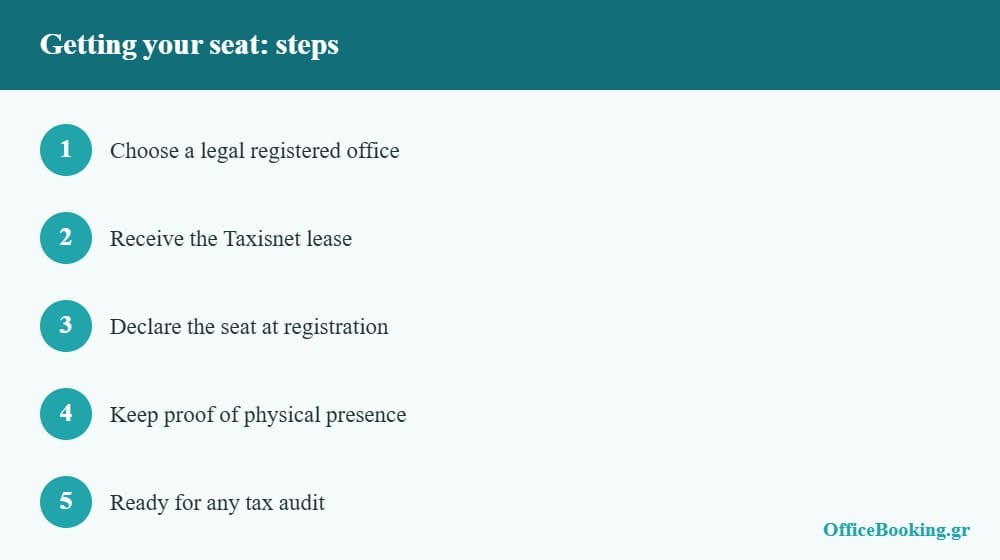
Activation is fast on purpose. Send us your company details and ID, we prepare the lease and supporting documents, and most clients have a signed, Taxisnet-ready registered office within about 24 hours. That timeline matters when your formation is waiting on a confirmed seat before GEMI or the tax office will move forward.

Step-by-step: activating your IKE company Greece registered office

  1. Send basic details. Your name, the company name for the IKE, and a copy of ID.
  2. We prepare the lease. A real lease for a named locker at our Heraklion address, ready for Taxisnet.
  3. You get the paperwork. Signed lease plus any supporting documents your accountant needs for the GEMI or tax filing.
  4. Go live in about 24 hours. Your company has a legal, audit-proof registered office from day one.

Everything outside the seat itself — drafting the articles of association, GEMI submission, opening a bank account, VAT registration — stays with your accountant or lawyer. We are not a formation service; we are the registered office your accountant will ask you to confirm before they can finish the paperwork.

IKE company Greece registered office: cost vs renting a real office

Every new company here needs a declared seat before GEMI or the tax office will finalise anything. Founders usually compare three routes: sign a lease for a traditional office, use a bare “virtual address” reseller, or take a real but compact registered office like ours. The table below lines them up side by side.

OptionMonthly costPhysical presenceSurvives a ΔΟΥ auditContract
Traditional office rental€300-€600+YesYesUsually 1-3 years
Bare “virtual address” reseller€20-€40NoNo — flagged on inspectionVaries
OfficeBooking.gr registered office€59.90Yes — named locker + deskYesMonthly, no lock-in

The middle option is the trap: it is cheap, but a “virtual address” with no real desk or locker cannot survive a ΔΟΥ αυτοψία, and your company could be asked to re-declare its seat mid-operation. Our locker carries your company name, sits inside a real shared office in Heraklion, and comes with 4 hours a month of desk access — enough to receive an inspector, sign a document, or meet a client if you ever need to.

For freelancers, e-shop owners and dropshippers forming an IKE who do not need daily desk space, this is usually the whole answer: one address that is legally sound, cheap enough to ignore, and ready before the rest of the paperwork is done.

IKE vs branch vs sole trader: a quick comparison

OptionLiabilitySetup speedNeeds a seat?
IKE company GreeceLimitedFast (online)Yes — legal registered office
Branch officeParent companyModerateYes — registered address
Sole traderUnlimitedFastYes — professional seat

Whichever form you pick, a legal seat is non-negotiable — which is why solving the address first saves you time and money.

Who is an IKE company Greece right for?

It fits freelancers, dropshippers and e-shop owners who work from anywhere and need no physical office, but do need a compliant seat. It also suits foreign founders and expats who want a credible Greek address instead of a friend’s apartment, and partners who prefer a neutral business address rather than someone’s home.

  • Real physical presence with a named locker — not a mailbox.
  • A lawful Taxisnet declaration that withstands a ΔΟΥ audit.
  • From €59.90/month — about one tenth of an office.
  • Active in ~24 hours, in Heraklion, Crete.

One more group fits well here: remote teams that form an IKE company Greece to hire locally but run operations from abroad. They need the seat purely as a legal anchor — a place GEMI, the tax office and, eventually, banks can point to — and almost never need the desk itself. A registered office that only exists on paper is fine for a bank; it is not fine for a tax inspector, which is why ours is real either way. Paying full office rent for a legal formality makes little sense, which is exactly the gap a real but compact registered office like ours is built to close.

Common mistakes when forming an IKE company Greece

The most frequent mistake is leaving the seat for last and grabbing the cheapest virtual address available, only to fail an inspection later. Others overpay for a full office they barely use, or declare a home address and then struggle to change it. Decide the registered office early, make sure it is a real, declarable seat, and keep the tax steps with your accountant.

FAQ about setting up an IKE company Greece

How long does it take to register an IKE company Greece?

Through the e-ΥΜΣ One-Stop-Shop, the formation itself can be done in a day or two. The registered office with OfficeBooking.gr is active in about 24 hours, so the seat is never your bottleneck.

Can a foreigner own an IKE company Greece?

Yes. Non-residents can own and manage an IKE. You will need a Greek tax number (AFM) for the partners — ask your accountant — and a legal registered office, which we provide.

Is a shared-space (co-working) registered office legal for an IKE?

Yes, when it is a real, declarable seat with physical presence — like ours, with a named locker and a Taxisnet lease. A pure “virtual address” with no presence is the risky option.

What is the minimum capital for an IKE company Greece?

Just €1. The IKE was designed to remove capital barriers, which is part of why it is so popular with new founders.

What happens if the tax office (ΔΟΥ) visits my IKE company Greece registered office?

An auditor can ask to see the locker and the lease. Because both are real — a named space at Αναξαγόρα 23, Ηράκλειο Κρήτης, backed by a genuine Taxisnet lease — there is nothing to explain away. This is the exact scenario a “virtual address” cannot survive.

Can I use a PO box or mail-forwarding address for my IKE company Greece?

No. Taxisnet requires a real, physical seat, and a PO box or forwarding address does not qualify. Our locker and shared desk meet the legal definition of a registered office, which a mailbox does not.

Can an e-shop or dropshipping business use this registered office for its IKE company Greece?

Yes. Online sellers rarely need daily floor space, so paying for a full office just to satisfy the registered-office requirement is wasted money. Our named locker and Taxisnet lease give an e-shop or dropshipping business a fully legal seat without renting space nobody will use.

Does the registered office affect how fast my IKE company Greece gets its VAT number?

Indirectly, yes. GEMI and the tax office both need a confirmed seat before they finalise registration. Because our lease is ready in about 24 hours, the registered office is rarely what slows down the rest of the company setup — talk to your accountant about the VAT and AFM steps themselves. If you want a second opinion on timing, our team can tell you exactly when your Taxisnet lease will be ready so you can plan the rest of the filing around a fixed date instead of guessing.

Conclusion: start smart, not expensive

An IKE company Greece is one of the simplest, cheapest ways to run a compliant business — but it is only complete when you have a registered office that stands up legally. For the tax and accounting steps, lean on your accountant. For the seat, talk to us and we will activate your legal registered office in about 24 hours, from €59.90/month. You can also check the official procedures on gov.gr.

Read More
Tax residency Greece 2026 - regimes, rules and how to apply

Tax Residency in Greece (2026): Regimes, Rules & How to Apply

Guides

Thinking about moving your tax residency to Greece? You are not alone. Tax residency Greece has become a popular search for retirees, remote professionals and entrepreneurs drawn by the country’s lifestyle, EU access and attractive incentive regimes. This 2026 guide explains how tax residency in Greece works, the special tax regimes you can apply for, how to change your residency, and how it connects to registering a company and a registered office.

What is tax residency in Greece?

Your tax residency Greece status determines where you are taxed on your worldwide income. In general, you become a Greek tax resident if Greece is the centre of your vital interests, or if you spend more than 183 days in the country within a 12-month period. Once you hold tax residency in Greece, you generally declare your global income to the Greek tax authority (AADE).

Establishing tax residency Greece is a formal process handled through the tax office (DOY) and Taxisnet. It is separate from citizenship or a residence permit, although they often go together for people relocating to Greece.

The 183-day rule and centre of vital interests

Two main tests decide tax residency in Greece. The first is the 183-day rule: spend more than half the year in Greece and you are typically a tax resident. The second is the centre of vital interests — where your family, home and economic activity are based. If your life and business move to Greece, your tax residency Greece status usually follows.

Understanding these tests early helps you plan your move and avoid being taxed as a resident in two countries at once.

Special tax regimes for new residents

One of the biggest reasons people pursue tax residency Greece is the country’s incentive regimes for new tax residents:

  • Non-dom regime (high-net-worth): a flat annual tax on foreign income for qualifying individuals who invest in Greece.
  • Foreign pensioners (7%): retirees moving to Greece may benefit from a flat 7% rate on foreign-source income for several years.
  • Relocating professionals and employees (50% exemption): people who move their tax residency to Greece for work may have a large portion of their Greek income exempted for a number of years.

Each regime has its own conditions and time limits. A licensed Greek tax advisor can confirm which one fits your situation before you commit to tax residency in Greece.

How to change your tax residency to Greece

  1. Get a Greek tax number (AFM) and Taxisnet credentials.
  2. Establish your presence — a home, and often a registered economic activity.
  3. File the tax residency transfer with the competent DOY, providing the required documents.
  4. Apply for a special regime if you qualify, within the relevant deadlines.

The process is administrative but precise, so timing and documentation matter. Many people combine their tax residency Greece application with setting up a business in the country.

Tax residency and registering a company

For entrepreneurs, tax residency in Greece often goes hand in hand with registering a company. If you plan to run a business from Greece, you will likely enter the Greek business register (GEMI) and obtain a VAT number. Both your company and your personal tax residency Greece status then sit within the Greek system.

This is where many newcomers underestimate one requirement: every Greek company needs a registered office address.

The registered office connection

Whether you are establishing tax residency in Greece, registering a company, or both, a legal registered office is a practical necessity. Your company’s seat must be declared on Taxisnet, and a vague virtual address can be rejected or fail a DOY audit.

OfficeBooking.gr provides exactly this: a legal registered office with a Taxisnet lease, a personal locker and shared-desk rights, from €59.90 a month and active in up to ~24 hours. It removes the address obstacle so you can focus on your tax residency Greece planning and your business.

Benefits of tax residency in Greece

Beyond the incentive regimes, tax residency Greece offers EU residence, a high quality of life, and access to the European market. For remote workers and digital nomads, it combines a favourable base with the freedom to serve clients worldwide. For retirees, it can mean a simpler, lower tax life in a Mediterranean setting.

Common mistakes to avoid

The most common mistake is assuming tax residency in Greece is automatic — it requires formal steps and documentation. A second is missing the deadlines for a special regime, which can cost years of savings. A third, for entrepreneurs, is leaving the registered office to the last minute, which delays both the company and the tax setup.

The non-dom regime in detail

The Greek non-dom regime targets high-net-worth individuals who transfer their tax residency Greece and make a qualifying investment in the country. In exchange, they pay a fixed annual amount on their foreign-source income, regardless of how much that income is, for up to 15 years. It can be extended to close family members for an additional fee.

This regime is popular with international investors who want a predictable tax bill and an EU base. As always, eligibility and the investment threshold should be confirmed with a tax advisor before you move your tax residency to Greece.

The 7% regime for foreign pensioners

Retirees are a major group pursuing tax residency in Greece. Under the pensioner regime, qualifying foreign retirees who transfer their tax residency Greece can pay a flat 7% rate on their foreign income — including pensions — for up to 15 years. To qualify, you generally must not have been a Greek tax resident in most of the previous years and must move from a country with which Greece cooperates on tax matters.

For many pensioners, this turns Greece into both a lifestyle and a financial upgrade.

The 50% exemption for relocating workers

To attract talent, Greece offers a regime where individuals who move their tax residency Greece to take up employment or self-employment can have up to 50% of their Greek-source income exempted from tax for several years. This is aimed at professionals, employees and freelancers relocating to the country, and it pairs well with remote and hybrid work.

If you are a remote professional considering a Greek base, this regime — combined with a legal registered office for any business activity — can make the move highly efficient.

Tax residency and the digital nomad trend

Greece has actively courted digital nomads and remote workers, and tax residency Greece is increasingly part of that conversation. While a digital nomad visa governs your right to stay, your tax residency determines where you pay tax. Many nomads who settle in Greece eventually formalise both their residency and a small business, entering the Greek business register and securing a registered office.

Getting the structure right from the start — residency, company and registered office — avoids surprises later.

Avoiding double taxation

A key concern when changing tax residency to Greece is being taxed twice on the same income. Greece has double-tax treaties with many countries, which set tie-breaker rules and credits to prevent this. The practical takeaway: coordinate your exit from your old tax residency and your entry into tax residency Greece carefully, ideally with advisors in both countries.

Frequently asked questions

How many days do I need to spend in Greece for tax residency?

Generally more than 183 days in a 12-month period, though the centre-of-vital-interests test can also apply. Your tax residency Greece status depends on the full picture.

Can I keep tax residency elsewhere?

Dual residency situations are resolved through double-tax treaties and the tie-breaker rules. A tax advisor will assess your specific case before you change tax residency to Greece.

Do I need a company to move my tax residency?

No, but many people who move their tax residency Greece also register a business. If you do, you will need a registered office for that company.

How long do the special regimes last?

The non-dom and pensioner regimes can run for up to 15 years, and the relocation exemption for several years. Confirm the current terms when you plan your tax residency Greece move.

Do I need a registered office for tax residency?

Not for personal tax residency itself. But if you also register a company, that company needs a registered office — which is quick to arrange and keeps your whole setup compliant.

Tax residency vs residence permit vs citizenship

It helps to separate three things people often confuse. A residence permit gives you the legal right to live in Greece. Citizenship makes you a national. Tax residency Greece, by contrast, is purely about where you are taxed. You can hold a residence permit without being a tax resident, and vice versa. When planning a move, treat your tax residency Greece status as its own decision, with its own paperwork and deadlines.

Planning your move: a practical timeline

A smooth transition to tax residency in Greece usually follows a clear timeline. Several months ahead, you assess which regime fits and gather documents. As you relocate, you obtain your AFM and Taxisnet access, and, if needed, register your company and secure a registered office. After the move, you file the residency transfer and apply for your chosen regime within the deadlines.

Treating tax residency Greece as a project — rather than an afterthought — is what keeps the savings intact and the process stress-free. The administrative foundations, especially the registered office for any business, are the easiest to arrange and the ones that most often cause delays when left late.

Why getting the foundations right matters

Whatever your reason for pursuing tax residency Greece, the building blocks are the same: a tax number, a clear regime, proper filings, and — for entrepreneurs — a company in the business register with a legal registered office. Get these in order and Greece becomes a genuinely efficient base. Leave them to chance and you risk double taxation, missed deadlines or a rejected company seat.

Conclusion

Moving your tax residency to Greece can be a smart, rewarding decision — especially with the country’s incentive regimes. Plan the tax side with a licensed advisor, and solve the practical foundations early. If your move includes a business, see how to navigate the Greek business register and get a legal registered office, or contact us for your seat. This information is provided for general guidance; always consult a qualified Greek tax advisor.

Read More
Business register Greece (GEMI) - how to register a company in Greece

Business Register Greece (GEMI): How to Register a Company in 2026

Guides

If you are planning to start a business in Greece, your first stop is the business register — in Greece this is GEMI (the General Commercial Registry). Searching for how the business register Greece works is one of the most common steps for foreign founders, freelancers and companies expanding into the country. This 2026 guide explains exactly what the Greek business register is, how to register a company in Greece step by step, what it costs, and the one requirement many people overlook: a legal registered office.

Business register Greece (GEMI): registered office for company registration

What is the business register in Greece (GEMI)?

The business register Greece relies on is called GEMI (Γενικό Εμπορικό Μητρώο, the General Commercial Registry). Every company and most professionals must be entered in this business register to operate legally. Think of the business register Greece keeps as the official public record that proves your company exists, who owns it, and where its registered office is.

Registration in the business register Greece maintains is mandatory for companies such as IKE (private company), OE and EE (partnerships) and AE (société anonyme), and it links directly to the tax authority (AADE) through Taxisnet. Without a GEMI entry, you cannot issue invoices or operate as a legal entity.

Why register a company in Greece

There are strong reasons to register a company in Greece in 2026. The country offers access to the EU market, a growing startup and digital-nomad ecosystem, and competitive corporate tax rates. For many founders, registering on the Greek business register is also the step that unlocks a Greek VAT number, business banking and the ability to trade across Europe.

Whether you are an e-commerce seller, a consultant or a foreign company opening a branch, an entry in the business register Greece operates is what turns your idea into a recognised, invoice-issuing business.

Types of company you can register

Before you approach the business register, choose your legal form:

  • IKE (Private Company): the most popular choice for small businesses and startups, with low minimum capital.
  • OE / EE (partnerships): simpler structures for two or more partners.
  • AE (société anonyme): for larger companies with higher capital requirements.
  • Sole proprietorship (atomiki): for freelancers and individual professionals.

Each form has its own steps in the Greek business register, but every business register Greece entry shares one requirement: a declared registered office address.

How to register a company in Greece: step by step

  1. Get a Greek tax number (AFM) for each founder, and Taxisnet credentials.
  2. Choose your company name and legal form and prepare the articles of association.
  3. Secure a registered office address — a legal seat declared on Taxisnet (more on this below).
  4. File with the business register Greece runs (GEMI), often through the one-stop service (e-YMS) for faster company formation.
  5. Receive your GEMI number and VAT registration, then activate the company with the tax office (DOY).

Done correctly, registering a company in Greece through the business register can be completed remotely and relatively quickly.

The registered office: the requirement most people miss

Here is the step that trips up most foreign founders. To register a company in Greece, the business register requires a registered office — a real, declared address for your company. You cannot complete your GEMI entry without one, and a purely virtual address with no substance can be rejected or fail a later DOY audit.

This is exactly what OfficeBooking.gr provides: a legal registered office with a Taxisnet electronic lease, a personal locker bearing your company name, and shared-desk rights — from €59.90 a month. It gives your business register entry a real, audit-proof seat without the cost of renting an office. If you are registering a company in Greece from abroad, this is the fastest way to satisfy the address requirement.

How much does company formation in Greece cost?

The cost to register a company in Greece depends on the legal form, but typically includes GEMI fees, notary and accountant fees (for some forms), and the registered office. The business register fees themselves are modest; the larger variable is often the registered office and professional support.

With a flexible registered office at €59.90/month instead of a €5,000+/year office lease, you keep your company-formation budget low while still satisfying every requirement of the Greek business register.

Tax and VAT after you register

Once your company is in the business register, you receive a Greek VAT number and become subject to Greek corporate tax and VAT obligations. Many founders also look into tax residency in Greece, which can offer attractive regimes for new residents. Your accountant will guide you on filings, but the foundation — a valid business register entry and a legal registered office — must be in place first.

How long does it take?

Through the one-stop service, simple company forms can be registered on the Greek business register within a few days. The registered office part is the quickest to solve: with OfficeBooking.gr your seat can be active on Taxisnet in up to ~24 hours, so it never becomes the bottleneck in your company formation.

Common mistakes when using the business register

The most frequent mistake is leaving the registered office to the last minute, then using a cheap virtual address that the business register or a future audit rejects. A second mistake is choosing the wrong legal form for your situation. A third is ignoring ongoing obligations — once you are in the Greek business register, you must keep your details and filings up to date.

The one-stop service (e-YMS) explained

Greece has simplified company formation through a one-stop service (e-YMS), an online platform that lets you complete several steps of the business register process in one place. For standard company types with model articles of association, you can submit your incorporation and receive your GEMI number digitally, often without a notary.

This is good news for foreign founders: much of the interaction with the Greek business register can be done online, provided your paperwork — including your registered office lease — is ready. Preparing the registered office in advance is what keeps the e-YMS process fast and smooth.

Opening a business bank account

After your entry in the business register, the next practical step is a Greek business bank account. Banks will ask for your GEMI number, your VAT number and proof of your registered office address. A credible, verifiable registered office makes this step easier, while a vague virtual address can raise questions during onboarding.

Because OfficeBooking.gr gives you a real address at Anaxagora 23, Heraklion, with a named locker and a Taxisnet lease, your banking and invoicing paperwork all point to a consistent, legitimate seat.

Foreign companies: branch vs new company

If you already run a company abroad, you have two main paths into Greece: open a branch of your existing company, or register a brand-new Greek company. A branch extends your foreign entity into Greece, while a new company creates a separate Greek legal person. Both require an entry in the Greek business register and both need a Greek registered office.

The right choice depends on liability, tax and how permanent your Greek presence will be — a question for your accountant. Either way, securing the registered office early removes the most common delay.

Tax residency in Greece: a quick note

Many people who register a company in Greece also consider moving their tax residency to Greece. The country offers special regimes for new tax residents, including incentives for retirees, high-net-worth individuals and remote professionals. Tax residency is separate from registering a company, but the two often go together for relocating founders.

This guide focuses on the business register and the registered office; for personal tax residency planning, speak to a qualified Greek tax advisor.

Keeping your company compliant after registration

Being in the business register is not a one-off event. You must keep your details current, file annual statements, and maintain a valid registered office throughout the life of the company. If your declared address ever stops being real, you risk problems in the business register and in any future DOY inspection.

A managed registered office solves this for the long term: your seat stays valid, your mail is handled and scanned daily, and your business register entry always points to a genuine, audit-proof address.

Frequently asked questions

Can a foreigner register a company in Greece?

Yes. Foreigners can register a company in Greece, usually needing a Greek AFM (tax number) and a registered office address. Much of the business register process can be handled remotely.

Do I need a physical office to register?

You need a legal registered office, not necessarily a full office. A registered office with real substance — locker, lease and space — satisfies the business register and withstands a DOY audit.

What is GEMI?

GEMI is the Greek business register (General Commercial Registry) where companies are officially recorded. Your GEMI number proves your company is legally registered.

How long does GEMI registration take?

Through the one-stop service, simple companies can complete their business register entry within a few days, assuming the registered office and documents are ready.

Can the registered office be in a different city than where I live?

Yes. Your registered office can be in Heraklion while you live or operate elsewhere, because the whole process is remote. Many founders use this flexibility when they register a company in Greece.

Can I complete the business register Greece process from abroad?

In most cases yes, often through a power of attorney handled by your lawyer. The one piece you must have in place is a Greek registered office, and that is the part we provide remotely in about 24 hours.

Does the business register Greece require a physical office?

It requires a registered seat, not a rented room. A flexible registered office satisfies that requirement legally because it is a real location with a lease on Taxisnet, not a virtual mailbox.

Will my home address work as my seat?

It can, but it exposes your private residence to a tax inspection and is hard to undo later. A separate registered office keeps your home address off the public registry and out of an αυτοψία.

Business register Greece checklist for foreign founders

If you are about to register a company in Greece, use this quick business register Greece checklist before you start: confirm your legal form, obtain a Greek AFM for each founder, prepare your articles of association, and — most importantly — secure your registered office address. With these ready, your business register Greece submission through the one-stop service is straightforward.

Many founders underestimate how much smoother the entire company formation becomes when the registered office is sorted first. The business register Greece process, the bank account, the VAT number and the invoicing all depend on that single, verifiable address. Get it right at the start and you avoid the most common delays and rejections.

OfficeBooking.gr was built exactly for this moment: a legal, audit-proof registered office that satisfies the Greek business register, activates in up to 24 hours, and costs about one tenth of a traditional office. It is the simplest way to turn your plan to register a company in Greece into a live, compliant business.

One more thing worth knowing before you start the business register Greece process: the registry record is public, so the address you declare becomes visible to anyone who searches it. If you use your home, that address is searchable indefinitely and tied to your name; if you use a registered office, only our business address at Αναξαγόρα 23 in Heraklion appears on the public record.

This is another reason the seat decision deserves attention at the very beginning of the business register Greece process rather than the end. Founders who leave it until the last step often end up rushing a home declaration they later regret. Get the address right first, and the remaining steps fall neatly into place around a stable, audit-proof foundation that will not need re-filing six months later.

Why the business register Greece process starts with your seat

Before you touch the business register Greece workflow, you need one thing decided: where your company is legally based. The General Commercial Registry (ΓΕΜΗ) will not finalise a registration without a declared registered office, because the seat is what ties your company to a tax authority and a jurisdiction. That is why experienced founders sort the address first and treat the rest of the business register Greece process as paperwork that follows.

A registered office with OfficeBooking gives you that seat immediately: a named locker at Αναξαγόρα 23 in Heraklion, a shared desk you can use four hours a month, and a lease filed on Taxisnet. It is a real, visitable location — exactly what a ΔΟΥ inspector expects to find during an αυτοψία.

Registered office vs renting: the cost that decides your business register Greece budget

Renting an office purely to satisfy the business register Greece requirement is the most common way new founders overspend. A conventional office in a Greek city easily costs €5,000 or more per year once rent, utilities and municipal charges are added. A registered office with us starts at €59.90 per month — €48.30 plus 24% VAT — billed monthly, roughly one tenth of the cost, and active in about 24 hours.

For a freelancer, an e-shop or a foreign founder testing the Greek market, that difference is the gap between a lean launch and a heavy fixed cost. You still satisfy the registry; you simply do it without renting space you will rarely use.

Business register Greece for freelancers, e-shops and dropshippers

Most people we help through the business register Greece process are not opening a large company — they are freelancers, e-shop owners and dropshippers who need a compliant seat fast. For them the registered office is the whole solution: it satisfies the business register Greece requirement, keeps the home address private, and costs a fraction of an office. The rest of the formation is light paperwork their accountant can finish in days.

What the business register Greece does not cover — and who to ask

The business register Greece system records your company, but it does not advise you. Issuing an ΑΦΜ, selecting ΚΑΔ activity codes, choosing a legal form, and filing your taxes are all steps that sit outside both the registry and our service. For those, work with a Greek accountant or lawyer who can tailor the choices to your situation.

Our role is narrow and clear: we provide the registered office that the business register Greece process requires, and we keep it audit-ready. Setting expectations this way saves you time — you know which questions belong to your accountant and which belong to us.

Conclusion

The Greek business register (GEMI) is the gateway to operating legally in Greece — and a registered office is the one requirement you must not overlook. Solve the address first and the rest of your company formation becomes simple. See our registered office service, read the FAQs, or contact us to get an audit-proof registered office for your new Greek company in up to 24 hours. This information is provided for general guidance; always consult a licensed accountant or lawyer.

Read More
Flexible registered office at 1/10 of the cost of an office

A Registered Office at 1/10 of the Cost: How the Flexible Office Model Works

Guides

A flexible registered office is one of the first and most underestimated expenses of any new business. If you’re a freelancer, dropshipper or service provider, you probably pay — or are thinking of paying — thousands of euros a year for a space you almost never use. In this guide you’ll see how the flexible registered office model works, how it achieves 1/10 of the cost of a traditional office, and why a properly structured flexible registered office is legal, secure and affordable at the same time.

Flexible registered office in Heraklion at 1/10 of the cost

What a flexible registered office is

A flexible registered office is a 100% legal solution that gives small businesses a real address: you lease an office for your business with an electronic lease through Taxisnet, which you accept and use to start or amend your business at the DOY. You don’t need to rent a whole office — you just need a solution that gives you real, named presence in a professional space.

The contract explicitly includes your personal locker with your business name and 4 hours of shared desk use per month. So your registered office isn’t just an address on paper, but a space with substance.

Why a traditional office costs €5,000+ a year

When you think about the cost of an office, rent comes to mind first. In reality, an office hides much more: deposit, electricity, shared building costs, heating, internet, cleaning and equipment. Together, a typical office easily exceeds €5,000 a year.

For someone working from a laptop, that amount is pure waste. This is where a flexible registered office changes the picture, offering a legal office without the burden of a whole workspace.

How the model achieves 1/10 of the cost

The logic is simple: instead of each business paying for its own office, a flexible registered office shares an organised infrastructure, an organised infrastructure is shared. Everyone has their own locker and the right to use a shared space, while the fixed costs are distributed. So a flexible registered office costs about 1/10 of an office.

At OfficeBooking.gr a registered office starts from €59.90 a month (€48.30 + VAT), with flexible monthly payment. There are no hidden fees, deposits or long-term commitments — you pay a predictable monthly amount and have everything ready.

What your registered office includes

A complete registered office is more than an address. It includes:

  • Electronic lease on Taxisnet: a legal lease for starting or amending your business.
  • Personal locker with your business name: a physical, named presence in the space.
  • 4 hours of shared desk per month: the right to use a real office.
  • Mail handling: every document is scanned and forwarded to your email.

These elements turn your registered office from a routine expense into useful infrastructure for your business.

Why it isn’t a “virtual address”

The big difference from simple P.O. boxes or “virtual offices” is physical substance. In a potential inspection by the DOY, there is a real space, a locker with your business name, and a documented right to use the office.

That makes all the difference for legality. A registered office with real substance survives an audit, while a purely virtual address is exposed. See the detailed virtual vs physical office comparison.

What you gain with a flexible registered office

  • Save €4,000–€6,000 a year in fixed costs.
  • Start or change your office in up to 24 hours.
  • Daily mail handling, scanned to your email.
  • A professional address for invoices, GEMI and clients.

In short, your flexible registered office stops being a burden and becomes a competitive advantage.

Who it’s ideal for

A flexible registered office is ideal for freelancers working from home who don’t want to declare their residence. It suits e-shops and dropshippers who need an address for invoices and GEMI without a warehouse. It also fits consultants and professionals who travel and want flexibility.

In all these cases, a registered office offers the legality of an office at a fraction of the cost and with no commitments.

Step by step: activation in 24 hours

  1. Check availability and confirm your activity is eligible.
  2. Receive and accept the electronic lease through Taxisnet.
  3. Your personal locker with your business name is activated.
  4. Start or amend at the DOY — your registered office can be active in up to ~24 hours.

The whole process is remote, with no bureaucracy and no need to visit an office in person.

Cost comparison: office vs registered office

CategoryTraditional officeRegistered office (OfficeBooking)
Monthly cost€400+€59.90
DepositYesNo
UtilitiesYesNo
CommitmentLong-termMonthly
Legal officeYesYes

Legality and coverage in a DOY audit

Many fear that an affordable solution isn’t “serious”. In reality, the OfficeBooking.gr registered office rests on a legal lease through Taxisnet and on real physical presence. So even in a DOY audit, there is something tangible for the inspector to see.

Affordability doesn’t come at the expense of legality. Instead, you get both: low cost and a registered office that stands up to any inspection.

How payment and VAT work

The €59.90 price breaks down into €48.30 plus 24% VAT. Payment is monthly, by card, with no advance or deposit. That means the cost is fully predictable and easy to budget each month.

Because the expense relates to running the business, in many cases it’s tax-deductible — which further reduces the real cost. Check with your accountant for your specific case.

The advantage of an office in Heraklion

Our office is located in Heraklion, Crete, in a real working space. That means a fixed, verifiable address bearing your business name, regardless of where you live or travel. Your registered office gains a local footprint and substance, without tying you down geographically in your daily routine.

Business center, co-working or a flexible solution?

There are several options on the market. A business center offers a full office at a high monthly cost, often above €300–€500. A co-working space gives you a desk, but doesn’t always focus on the legal coverage of your address. A simple mailbox provides only an address, with no substance.

A flexible registered office sits exactly in the gap: it combines the low cost of a simple address with the real presence of an office. It is the balance between economy, legality and flexibility.

Common mistakes when looking for a cheap solution

The most common mistake is to look only at the price. A very cheap “virtual” address can cost you dearly if it doesn’t stand up in an audit. A second mistake is ignoring mail handling: if you miss a document from the tax office, the consequences can be serious.

A third mistake is long-term commitments. Many solutions require annual contracts or deposits. A flexible monthly registered office leaves you in control, so you can adapt as your business grows.

How to choose the right flexible registered office

Before deciding, evaluate four things: legality (is there an electronic lease?), physical substance (is there a real space and locker?), mail handling (will you actually receive your documents?), and flexibility (is there a monthly option or a long lock-in?).

A flexible registered office covers all four. When all four are covered, you have a solution you won’t need to change again. That is exactly the philosophy behind our registered office: a complete, affordable and legal choice from day one.

A real savings example

Let’s look at simple numbers. A freelancer renting a small office at €400 a month spends €4,800 a year, before deposit and utilities. With a flexible registered office at €59.90, the annual cost drops to about €719. The difference, over €4,000 a year, can be reinvested in the business.

For an e-shop or dropshipper that doesn’t need a physical store, the saving is even more logical: you pay only for what you actually need — a legal and reliable address.

A registered office and professional credibility

Beyond cost and legality, a stable professional address builds trust. Clients, suppliers and banks treat a business with a serious, named office differently from one that looks temporary. Your registered office is, in effect, part of your image in the market.

When you send an invoice or sign a contract, your address says something about how organised your business is. A complete solution with a locker, space and mail handling reinforces that image at no extra cost.

Why flexibility matters for small businesses

The needs of a small business change quickly. Today you may work alone, in six months have partners, and in a year need something different. A monthly, flexible solution lets you adapt without being locked into long-term costs.

Instead of tying up capital in an office you may not need, you keep your resources liquid and invest them where they truly matter: product, marketing and growth. Managing the cost of your registered office wisely is a small but important step in that direction.

Frequently asked questions about a registered office

Is a flexible registered office legal?

Yes. It rests on an electronic lease through Taxisnet and a real space with a locker, so it’s fully legal and accepted for starting or amending a business.

How much does it cost?

A registered office starts from €59.90 a month (€48.30 + VAT), with flexible monthly payment and no hidden fees.

How fast is it activated?

Your flexible registered office can be active on Taxisnet in up to ~24 hours after the paperwork is completed.

Is there a commitment, or can I stop anytime?

Payment is monthly and flexible. No long-term contract is required, so you keep control according to your business needs.

Can I use it to start a new business?

Yes. The electronic lease is issued and used both for starting and for amending a registered office at the DOY.

Does a flexible registered office work for an e-shop or dropshipping business?

Yes. An online store still needs a declared legal seat, and a flexible registered office provides one without forcing you to rent retail space you never use. Your stock and parcels can live wherever you operate, while your statutory address stays compliant at Αναξαγόρα 23 in Heraklion.

Can a foreign founder use a flexible registered office in Greece?

Yes. Many expats and non-resident founders use a flexible registered office as the Greek seat for their company. You get a real address that satisfies the registration requirement, and your accountant then handles tax residency and any cross-border filing specific to your situation.

What happens to my registered office if I move house?

Nothing changes. Because your seat is anchored to our address rather than your home, moving house does not trigger a change-of-seat declaration. Your flexible registered office stays exactly where it is, which keeps your records stable and your audit trail clean.

Do I get a real lease for the address?

Yes. You receive a genuine lease that can be filed on Taxisnet, which is precisely what makes the seat hold up in an αυτοψία. This is the core difference between a flexible registered office and a virtual mailbox that gives no enforceable right to the space.

What you need to get started

Getting started is simpler than most people think. You need your business or personal details for the start-up, access to your Taxisnet credentials to accept the lease, and your accountant’s input for the start or amendment at the DOY. We handle everything else.

Within a few hours you have a registered office ready and active, without leaving your office or home. This ease is one of the main reasons the model is becoming increasingly popular among freelancers and small businesses.

A flexible registered office as an investment, not an expense

If you look at the numbers overall, a registered office stops being just another cost and becomes a smart investment. You pay a small, fixed amount and gain legality, an address, mail handling and a professional image — all at 1/10 of the cost of an office.

For a new or small business, that difference can be decisive. The money you save each year is capital you can channel into growth, instead of leaving it tied up in the fixed costs of a space you don’t fully use.

Many of our clients are freelancers, e-shop owners and dropshippers who would otherwise declare their seat at home and expose their private residence to an αυτοψία. A flexible registered office keeps your home address private while giving the tax office a real, visitable location — the kind of separation that pays for itself the first time you are asked to prove your seat is genuine.

Real physical presence: what makes a flexible registered office audit-proof

The difference between surviving a ΔΟΥ audit and failing one comes down to a single question: is there a real place the tax office can visit? A flexible registered office answers yes. At Αναξαγόρα 23 in Heraklion you have a named locker carrying your company’s name and a shared desk you can use four hours every month, all backed by a registered lease filed on Taxisnet. When an inspector performs an αυτοψία, they find a genuine business location with your signage — not an empty mailbox.

This is exactly where a so-called “virtual address” collapses. A flexible registered office is built on real square metres, a real contract and real access rights, so it withstands scrutiny that a paper-only address cannot. For freelancers and small companies that want to keep costs low without taking legal risk, that physical backing is the entire point.

Flexible registered office pricing explained: €59.90 a month

A flexible registered office starts at €59.90 per month — €48.30 plus 24% VAT — billed monthly with no long lock-in. Compare that to a conventional office in a Greek city, where rent, utilities, cleaning and municipal charges routinely push the real cost past €5,000 a year. The flexible model lands at roughly one tenth of that, which is why it suits people who need a legal seat but not a room they will rarely sit in.

The pricing is transparent: you pay for the registered address, the named locker and your monthly desk hours, and nothing hides behind setup fees. Because the VAT is standard, businesses on a normal regime reclaim it like any other expense — a point your accountant can confirm for your specific case.

What you receive with your flexible registered office in Heraklion

When you activate a flexible registered office you receive everything needed to register the address as your statutory seat: a copy of the lease for Taxisnet, your named locker, your monthly desk allocation and a real street address at Αναξαγόρα 23, Ηράκλειο. Activation typically completes in about 24 hours, so you are not waiting weeks to declare your seat.

For the steps that sit outside the address itself — issuing an ΑΦΜ, choosing your ΚΑΔ activity codes, registering with ΓΕΜΗ or filing taxes — speak with your accountant or lawyer. Our role is the seat: we give you a compliant, audit-ready registered office, and your professional advisor handles the formation paperwork around it.

Conclusion

You don’t have to pay like you have an office to have a legal one. With a flexible registered office you keep costs at 1/10, retain full legality and gain real presence. See our FAQs, explore our services, or contact us to activate your registered office in up to 24 hours. This information is provided for general guidance; always consult your accountant.

Read More
DOY audit with a digital registered office - how you are covered

DOY Tax Audit with a Digital Registered Office: The Facts & How You’re Covered

Guides

A DOY audit is one of the biggest fears for any freelancer or e-shop owner operating with a digital or virtual registered office. “What happens if the tax office audits me?” is the most common question we hear. The truth is that the outcome of a DOY audit doesn’t depend on luck, but on how your registered office is set up. In this guide you’ll see exactly what a DOY audit checks, where digital offices are exposed, and how a physical registered office covers you completely.

DOY audit with a digital registered office - how you are covered

What a DOY audit is and when it happens

A DOY audit is the process by which the Greek tax office confirms that a business operates legally and that the details it has declared are true. It can happen for several reasons: random sampling, data cross-checks, a complaint, or as part of a start-up or amendment.

A large part of any DOY audit concerns the registered office. The tax office wants to verify that the declared address corresponds to a real space. This is exactly where many digital or virtual offices fail, while a properly structured physical office passes a DOY audit without trouble.

What the DOY checks in an inspection

In an audit or on-site inspection, the inspector wants to confirm a real presence at the declared address. Specifically, they look for:

  • a space genuinely connected to the business;
  • signage or a company name that identifies the activity;
  • a legal lease or right to use the space;
  • evidence that the office is not just a name on a list.

When these exist, a DOY audit is completed smoothly. When they’re missing, the problems begin.

Digital office and DOY audit: where the risk is

The term “digital office” isn’t bad in itself. The problem arises when a digital office has no physical substance. An address that exists only on paper, with no locker, signage or right to use space, is vulnerable in a DOY audit.

By contrast, a digital office backed by a real space — like OfficeBooking.gr — combines the convenience of remote management with the security of physical presence. So even if a DOY audit comes, there is something real for the inspector to see.

Why simple mailboxes get rejected

A P.O. box or a “mail-only” address is often not accepted as a registered office, because it proves no physical substance. In a DOY audit, such a solution offers no evidence of operation.

That’s the source of most rejections and headaches: the business thought it had a legal office, but in practice couldn’t prove its presence. The difference between a simple mailbox and a physical office with a locker is decisive for the outcome of a DOY audit.

How the OfficeBooking.gr model covers you

The OfficeBooking.gr model is designed specifically to withstand a DOY audit. It rests on four elements:

  • Electronic lease on Taxisnet: a legal lease accepted by the DOY for starting or amending your business.
  • Personal locker with your business name: a physical, named presence in the space.
  • 4 hours of shared desk per month: a documented right to use the office, inside the contract.
  • Mail handling: every document from the DOY reaches you the same day, scanned.

With these four elements, your office has substance — not just an address. A DOY audit becomes a simple formality.

Step by step: what to do if a DOY audit comes

  1. Stay calm — a DOY audit is a routine procedure, not an accusation.
  2. Have your electronic lease and office details ready.
  3. Show the physical presence: the locker with your name and the space you can use.
  4. Coordinate with your accountant for any extra document requested.

When your office is properly structured, you don’t need to worry about any DOY audit.

What the legal framework says

Declaring a registered office in Greece is done through the registry of the AADE and Taxisnet. The law doesn’t forbid using flexible or shared spaces as an office; it requires the address to correspond to a real space you can use and that relates to the business. In a DOY audit, that is exactly what’s examined.

So a solution with an electronic lease and a physical space is fully compatible with the framework, while a plain paper address risks being judged insufficient.

What happens if an office fails a DOY audit

When an office doesn’t prove physical substance, the consequences of a DOY audit can be serious — from fines to challenges over the validity of the office, problems issuing invoices, and complications with the business registry (GEMI).

In the worst cases, the tax office may retroactively dispute the operation at that address. The “saving” from a cheap virtual solution evaporates against the cost and time of recovering from a problematic DOY audit.

Real scenarios: freelancer, e-shop, dropshipper

A freelancer working from home often doesn’t want to declare their residence as an office. A physical registered office gives them a professional address that stands up to a DOY audit without exposing their home.

An e-shop or dropshipper needs an address for invoices, GEMI and partnerships, but usually has no warehouse or office. An office with a locker and a right to use space covers this need and survives a DOY audit at the same time.

How mail handling protects you

Much of the communication with the tax office happens in writing. Notices and documents arrive at the declared address. If it has no organised handling, you risk missing an important deadline and being exposed in a later DOY audit.

With daily mail handling, every document is scanned and forwarded to your email, while originals are kept in your locker. You never miss a notice and are always prepared.

Digital office with substance vs a plain address

CriterionPlain addressPhysical office (OfficeBooking)
Survives a DOY auditLowHigh
Physical presenceNoYes (locker)
Taxisnet leaseRarelyYes
Mail handlingNoDaily
CostLow€59.90/month

Preparation checklist for any inspection

The best defence is preparation. With a simple checklist, you’re always ready when the tax office knocks:

  • Electronic lease posted and accepted on Taxisnet.
  • A named locker that identifies your business in the space.
  • Recent invoices and activity records, organised.
  • Contact details up to date in the registry.
  • Instant access to your scanned mail.

When the above are in place, an inspection becomes a simple confirmation rather than a stressful experience.

Sampling or targeted? The forms of a tax audit

Not all tax audits are the same. Some arise from random sampling, others from data cross-checks, and others are targeted — for example after a change of registered office. In every case, the common thread is verifying real presence.

That means it isn’t enough to be “technically fine” on paper; you need an office that stands up in practice. A physical solution with a locker and a usable space covers you regardless of the form the audit takes.

Common misconceptions about a DOY audit

A common misconception is “if my business is small, it will never be audited”. In reality, data cross-checks involve businesses of every size, and a DOY audit can arise even for a brand-new sole proprietorship.

A second misconception is “as long as I pay my taxes, I’m fine”. Tax compliance matters, but it doesn’t remove the need for a valid office. The tax office separately examines whether the declared address corresponds to a real space. Finally, many think changing an office is complicated; in practice, with an electronic lease, it’s quick and remote.

The cost of a secure, legal office

Many professionals delay moving to a legal office, fearing the cost. In reality, a physical registered office starts from €59.90 per month — about 1/10 of the cost of an office. Compared with the fines and disruption of a problematic audit, the difference is enormous.

The logic is simple: you pay a small, predictable monthly amount and gain peace of mind against any future DOY audit. It’s an investment in the stability and legality of your business, not just another expense.

Why physical presence boosts your credibility

Beyond the tax office, a real professional address matters to third parties too. Clients, suppliers and banks see a stable address and perceive a serious, organised business. This credibility translates into easier partnerships and a better image in the market.

So investing in a legal, physical office doesn’t only protect you against the tax authority; it builds the trust you need to grow your business safely.

Frequently asked questions about a DOY audit

How often does a DOY audit happen?

There’s no fixed frequency. A DOY audit can be random, follow a data cross-check, or come as part of an amendment. That’s why structuring your office correctly from the start matters.

Will I be notified before the audit?

Not always. The tax office can inspect without warning, which is why physical presence must exist at all times.

Is a digital office covered in a DOY audit?

A digital office with real physical substance, a locker and a lease is covered. A purely virtual address with no substance is exposed.

What if I’m not present at the moment of the audit?

You don’t need to be in the space constantly. What matters in a DOY audit is the existence of a real, named presence — the locker and the space — along with the legal documents of the office.

Does the audit differ for a sole proprietorship and a company?

The logic is the same: the tax office confirms real presence at the declared address. The exact requirements may vary by legal form, so coordinating with your accountant is always useful.

How often does a DOY audit happen to small businesses?

There is no fixed schedule. A DOY audit can be triggered by risk-scoring algorithms, VAT refund claims, customer complaints, or random sampling. Freelancers and e-shops with a bare mailbox address are statistically easier targets, because a failed on-site verification (autopsia) is quick to establish. A seat with real physical presence — a named locker, a Taxisnet-registered lease and desk access — removes the easiest ground for rejection before the inspector even opens your books.

Can I pass a DOY audit while working from home?

You can declare your home as a seat, but it mixes personal and business exposure: inspectors may visit your residence, landlords often refuse business use, and the address appears on every invoice. A separate professional seat from €59.90/month keeps your home private and gives the inspection a clean, verifiable location with your company name physically present. For bookkeeping questions that follow an inspection, always involve your accountant.

The advantage of an office in Heraklion

Our office is located in Heraklion, Crete, in a real working space. In an inspection, there is a specific, verifiable address bearing your business name that an inspector can visit. It isn’t an abstract “digital” location, but a place where your presence can be confirmed.

This local footprint, combined with remote management, gives you the best of both worlds: a stable physical office and full flexibility in your daily work, wherever you happen to be.

A practical savings example

Consider a freelancer who would rent a small office at €400 a month — that’s €4,800 a year before deposit and utilities. With a physical office at €59.90, the annual cost falls to about €719. Over €4,000 a year stays in the business, while the legal coverage remains intact.

For an e-shop or dropshipper, the saving is even clearer: you pay only for what you truly need — a legal, credible address that holds up under scrutiny.

DOY audit timeline: from notification to the final report

Most on-site inspections follow a predictable arc. First comes selection: your AFM is flagged by risk criteria or sampling. Then verification: an inspector visits the declared seat, often unannounced, to confirm the business genuinely operates there. They look for the company name on the premises, someone who can answer for the entity, and consistency between the declared address and physical reality.

If the visit raises doubts, a written request for records follows, and you typically have a short statutory window to respond. The process closes with an audit report that either confirms your status or proposes corrections and fines. The single cheapest way to shorten this timeline is to make step two undramatic: when the inspector finds a real seat — locker with your company name, registered lease, staffed premises — the on-site part usually ends the same day.
The documents that decide a DOY audit outcome

Inspectors decide on paper as much as on presence. The documents that consistently matter for the seat question are: the lease or concession agreement registered on Taxisnet, proof the agreement is active and paid, the company’s display at the premises, and correspondence showing the address is genuinely used — received mail, forwarded notices, courier logs.

DOY audit preparation checklist for a digital registered office

With OfficeBooking.gr each of these exists by design: the concession is registered on Taxisnet when your seat is activated (usually within ~24 hours), your personal locker carries the company name, and mail handling produces a paper trail of real use. Keep tax filings and accounting records with your accountant — those are outside the seat service — but make sure they can be produced quickly when the report window opens.

Home seat, bare mailbox or OfficeBooking: your options compared

Before choosing where to declare your seat, compare what each option gives you on the day an inspector shows up:

CriterionHome seatBare mailboxOfficeBooking.gr seat
Survives on-site verificationUsually, but exposes your homeHigh rejection riskYes — real premises, named locker
Taxisnet-registered leaseDepends on landlord consentOften missingIncluded
Monthly cost“Free” but privacy cost€20–40€59.90 (€48.30 + 24% VAT)
Desk & meeting accessYour living roomNone4h/month shared desk
Privacy on invoicesNo — home address publicYesYes
Cost comparison before a DOY audit: office rent vs registered office seat

The pattern is consistent: a mailbox saves a few euros per month and risks the entire outcome of a DOY audit; a conventional office passes but costs roughly ten times more. A registered office with genuine physical presence sits in the middle — audit-ready at about one tenth of the cost of renting, active in about 24 hours, at Anaxagora 23, Heraklion, Crete.

After the DOY audit: keeping your seat audit-ready year-round

Passing one inspection does not archive the risk. Re-audits happen, especially after VAT refunds, address changes or activity-code updates. Treat audit-readiness as a standing property of your seat rather than a one-off scramble: keep the Taxisnet concession active and renewed, keep the company name visible on your locker, and keep the mail log growing — every forwarded notice is dated evidence that the address genuinely operates.

This is where a monthly, contract-light model helps. Because the OfficeBooking.gr seat renews month to month from €59.90, your registered address stays continuously valid without a long lease locking you in, and the physical infrastructure — locker, shared desk, staffed premises in Heraklion — is maintained for you. Your only recurring tasks are the ones that belong to your accountant anyway: filings, books and payroll. The seat itself stays quietly ready for whichever inspector arrives next.

Conclusion

A DOY audit isn’t something to fear, as long as your office has real substance. With an electronic lease, a personal locker and organised mail handling, you’re covered. Read about the virtual vs physical office difference, see our FAQs, or contact us about your case. This information is provided for general guidance; always consult your accountant.

Read More
Physical registered office vs virtual office in a Greek DOY audit

Virtual vs Physical Registered Office in Greece: Which One Survives a DOY Audit

Guides

Searching for a physical registered office in Greece, or wondering whether a cheap virtual office will do? It’s one of the most common questions new businesses face. If you work from home, travel, or run a dropshipping store, you don’t want to pay rent for a space you never use. But the term “virtual office” hides a serious trap when the time comes for a tax-office (DOY) audit. In this guide you’ll see the real difference between a virtual office and a physical registered office, what the tax authority checks during an inspection, and which solution actually protects you without raising your costs.

Physical registered office vs virtual office in a Greek DOY audit

What a virtual office really is

A virtual office is an address you declare as your company’s seat without any real space that you actually use. Often it’s an office address “rented” to dozens of businesses at once, on paper only. It’s cheap, fast and convenient, which is why many freelancers, dropshippers and e-shops are tempted.

The problem is simple: a purely virtual address, with no physical substance, is exactly what raises a red flag in a tax audit. A physical registered office solves this by giving you something real behind the address.

Why a virtual office is risky in a DOY audit

The DOY (Greek tax office) can inspect your declared address, even without warning. During such an audit, the inspector confirms that there is a real space at the address, that it is connected to your business through signage and records, and that there is a legal lease or right to use the space.

If nothing at the address proves your presence, the registered office can be challenged. Consequences range from fines to problems with the validity of your business and invoicing. In short, what you saved on rent with a virtual office you may pay back many times over. A physical registered office removes that risk entirely.

Physical registered office: the legal alternative

This is where a physical registered office makes the difference. Instead of an address “on paper”, you get a real space with proven, named presence. You don’t need to rent a whole office — you just need a solution that gives you genuine presence in a professional space.

At OfficeBooking.gr every member gets a personal locker bearing their business name inside our office, plus 4 hours of shared desk use per month. The office is declared legally on Taxisnet with an electronic lease, so it stands up to inspection because there is something real to see.

What the DOY checks in an inspection

In a typical audit, the inspector looks for concrete evidence of operation:

  • a real space at the declared address;
  • signage or a company name that identifies the activity;
  • a legal lease or right to use the space;
  • records showing the office is not just a name on a list.

When these exist, the audit is a routine formality. A physical registered office with a named locker and a shared desk ticks every one of these boxes.

Virtual vs physical registered office: detailed comparison

CriterionVirtual officePhysical registered office
Physical substanceNoYes (locker + shared desk)
Survives a DOY inspectionDoubtfulYes
Business name at the locationNoYes
Electronic leaseRarelyYes, on Taxisnet
Mail handlingRarelyDaily, scanned
CostLow~1/10 of an office (€59.90/mo)

How much a physical registered office costs

One of the supposed advantages of a virtual office is low cost. But a physical registered office isn’t expensive: at OfficeBooking.gr it starts from €59.90 per month (€48.30 + VAT), with flexible monthly payment — about 1/10 of the cost of a traditional office.

Physical registered office vs virtual address: what an inspector verifies

Given that a typical office costs €5,000+ a year in rent, deposit and utilities, the difference is huge. Compared with a virtual office, the small extra you pay buys you real legal security.

Step by step: a legal office in 24 hours

  1. Check availability and confirm your activity is eligible.
  2. Receive and accept the electronic lease through Taxisnet.
  3. Your personal locker with your business name is activated.
  4. Start or amend your registered office at the DOY — it can be active in up to ~24 hours.

The whole process is remote, with no bureaucracy, and replaces a risky virtual office with a physical registered office that stands up to any inspection.

Who should choose what

If you just want a cheap address and aren’t worried about audit risk, a virtual office seems convenient at first. But if you want to operate legally and worry-free — especially as a freelancer, e-shop or dropshipper who can be audited at any time — a physical registered office is the safe choice, at roughly the same cost.

You don’t have to choose between saving money and staying legal. With a physical registered office you get both, leaving behind the risks of a plain virtual office.

Mail handling and professional image

A point often ignored when choosing a virtual office is mail. Documents from the DOY, notices and official correspondence arrive at the declared address. If that’s a virtual office with no real handling, you risk losing important documents and deadlines.

With a physical registered office, every document is scanned and forwarded to your email the same day, while originals stay safe in your locker. Beyond legality, this gives you a serious professional image with clients, suppliers and banks.

Common myths about the virtual office

The most widespread myth is “a virtual office is enough as long as I’m never audited”. In reality, audits happen without warning, and the lack of physical substance leaves no room. A second myth is that “all address solutions are the same” — a simple mailbox is very different from a physical registered office with a locker, lease and right to use space.

Finally, many believe a physical office costs as much as renting one. As we saw, the cost is about 1/10 of an office, making a physical registered office the most sensible upgrade over a risky virtual office.

Virtual office, co-working or business center?

There are several options for a company address. A business center offers a full office at a high monthly cost. A co-working space gives you a desk, but doesn’t always focus on the legal coverage of your address. A simple mailbox provides only an address, with no substance.

A physical registered office sits exactly in the gap: it combines the low cost of a simple address with the real presence of an office, through a locker and a right to use a shared space. It is the balance between economy, legality and flexibility that a plain virtual office can’t offer.

What you need to declare your registered office

The process is simpler than most people think. In general you need your business or personal details for the start-up, the electronic lease issued and posted on Taxisnet, access to your Taxisnet credentials to accept it, and coordination with your accountant for the start or amendment at the DOY.

With an organised solution, all of the above is completed quickly and remotely. Within hours you have a physical registered office that is ready, active and audit-proof, without leaving your home or office.

Why physical presence matters for clients and banks

Beyond the tax office, a real professional address builds trust. Clients, suppliers and banks treat a business with a serious, named registered office differently from one that looks temporary. Your registered office is, in effect, part of your image in the market.

When you send an invoice or open a business bank account, your address says something about how organised your company is. A physical registered office with a locker, space and mail handling reinforces that image at a fraction of the cost of a traditional office.

The advantage of an office in Heraklion

Our office is located in Heraklion, Crete, in a real working space. That means a fixed, verifiable address bearing your business name, regardless of where you live or travel. In the event of an inspection, there is a specific location an inspector can visit and confirm your presence.

This local footprint, combined with remote management, gives you the best of both worlds: a stable physical registered office and full flexibility in your day-to-day work.

How to choose the right solution

Before you decide, evaluate four things: legality (is there an electronic lease?), physical substance (is there a real space and locker?), mail handling (will you actually receive your documents?), and flexibility (is there a monthly option or a long lock-in?).

When all four are covered, you have a solution you won’t need to change again. That is exactly the philosophy behind a physical registered office: a complete, affordable and legal choice from day one, instead of a cheap virtual office you may regret.

Frequently asked questions

Is a virtual office illegal in Greece?

The problem isn’t the term, but the lack of physical substance. A virtual office with no real space can be treated as an invalid registered office in an audit. A physical registered office solves exactly that.

Can I switch from a virtual office to a physical one?

Yes. You amend your registered office at the DOY, declaring the new physical address with the electronic lease. The process is quick and fully remote.

How fast is a physical registered office activated?

Your office can be active on Taxisnet in up to ~24 hours after the paperwork is completed.

Do I need to be present at the space every day?

No. The 4 hours of shared desk use per month are a right, not an obligation. What matters in an audit is the existence of a real, named presence — the locker and the space — not your constant physical attendance.

Can I have my office in a different city from where I live?

Yes. Your registered office doesn’t have to match your place of residence. Many professionals declare a physical registered office in Heraklion while living or travelling elsewhere, precisely because the process is remote.

Can a bank refuse my account because of a virtual office?

Yes, this happens in practice. During onboarding and periodic reviews, banks and payment providers verify that your declared seat corresponds to a real place of business. An address that resolves to a bare mail-forwarding service raises compliance flags and can delay or block the account. A physical registered office with a Taxisnet-registered lease and your company name on the premises gives the compliance officer exactly the evidence they ask for.

How fast can I move from a virtual address to a physical registered office?

The OfficeBooking.gr seat is typically active in about 24 hours: the concession is signed, registered on Taxisnet, and your named locker is prepared at Anaxagora 23, Heraklion. The change-of-seat declaration to the tax office is a separate administrative step — ask your accountant to file it, since filings sit outside the seat service itself.

A real savings example

Let’s look at simple numbers. A freelancer renting a small office at €400 a month spends €4,800 a year, before deposit and utilities. With a physical registered office at €59.90, the annual cost drops to about €719. The difference, over €4,000 a year, can be reinvested in the business.

For an e-shop or dropshipper that doesn’t need a physical store, the saving is even more logical: you pay only for what you actually need — a legal, reliable registered office that holds up in an audit.

Red flags that make a virtual office fail an inspection

Inspectors are trained to recognise addresses that exist only on paper. The classic red flags: dozens of unrelated companies declared at the same suite with no signage for any of them; no lease registered on Taxisnet, or a “service agreement” that grants no actual use of space; nobody on site who can speak for your business; and mail piling up unopened. Any one of these invites the conclusion that the seat is fictitious — and a fictitious seat can void VAT deductions and trigger fines.

The fix is not more paperwork but real infrastructure. A physical registered office answers each flag directly: your company name is displayed on a personal locker, the concession is registered on Taxisnet, staff are present during business hours, and correspondence is logged and forwarded to you.

How banks, clients and platforms see your registered office

The DOY is not the only party that checks your address. Banks run seat verification during account opening; payment processors and marketplaces (Stripe, PayPal, Amazon, Skroutz) ask for proof of business address; and B2B clients quietly look you up before signing. An address that maps to a real building with a real reception reads as an established business. One that maps to a virtual mailbox provider reads as a shell.

This reputational layer is where the physical registered office quietly pays for itself: one address that satisfies the tax office, the bank’s compliance team, and the client doing due diligence — for €59.90 a month instead of a €600+ office lease.

Physical registered office cost vs virtual address and office rental in Greece

Switching from a virtual address to a physical registered office

If you are already declared at a virtual address, upgrading is a low-friction, reversible-free process. First, activate the new seat — with OfficeBooking.gr the concession is signed and registered on Taxisnet in about 24 hours. Second, have your accountant file the change-of-seat declaration with the tax office; this is standard practice and does not interrupt your operations. Third, update your invoicing details, bank records and GEMI entry to the new address.

There is no penalty for the switch itself, and the timing is entirely yours — though most owners make the move before an audit letter arrives rather than after. For the declaration mechanics and any sector-specific requirements, rely on your accountant; for the seat itself, the infrastructure is ready the next working day.

Keeping your physical registered office audit-ready over time

Choosing the right seat once is half the job; keeping it verifiable is the other half. Three habits cover almost everything. Keep the concession active: the OfficeBooking.gr seat renews monthly, so the Taxisnet registration never lapses as long as the service runs. Keep the paper trail: every letter received and forwarded from your locker is dated evidence that the address genuinely operates — do not delete the notifications. Keep your registrations aligned: whenever you change activity codes, add a branch, or restructure, confirm with your accountant that the declared seat still matches what GEMI and the tax office have on file.
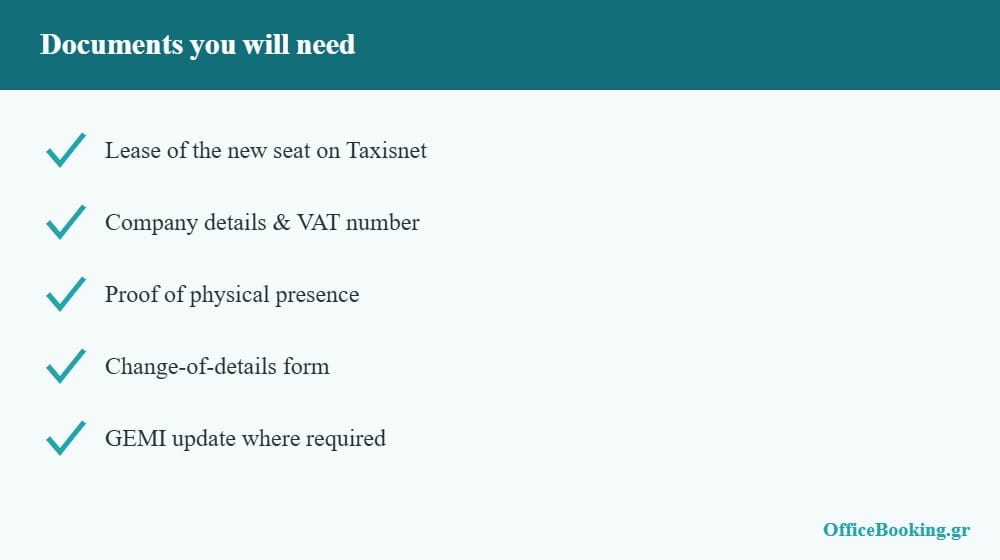
Owners who follow these three habits walk into an inspection with nothing to prepare, because the evidence has been accumulating on its own. That is the practical difference between an address you rent and infrastructure that works for you: the first needs defending, the second defends itself — at about one tenth of the cost of a conventional office, in a building with real staff in Heraklion, Crete.

Conclusion

A virtual office sounds economical, but its real cost shows up in an audit. With a legal physical registered office that has real substance, you keep the flexibility and remove the risk. Read our FAQs, learn more about a DOY audit with a digital office, or contact us to activate your office on Taxisnet in up to ~24 hours. This information is provided for general guidance; always consult your accountant.

Read More