

Searching for a physical registered office in Greece, or wondering whether a cheap virtual office will do? It’s one of the most common questions new businesses face. If you work from home, travel, or run a dropshipping store, you don’t want to pay rent for a space you never use. But the term “virtual office” hides a serious trap when the time comes for a tax-office (DOY) audit. In this guide you’ll see the real difference between a virtual office and a physical registered office, what the tax authority checks during an inspection, and which solution actually protects you without raising your costs.

What a virtual office really is
A virtual office is an address you declare as your company’s seat without any real space that you actually use. Often it’s an office address “rented” to dozens of businesses at once, on paper only. It’s cheap, fast and convenient, which is why many freelancers, dropshippers and e-shops are tempted.
The problem is simple: a purely virtual address, with no physical substance, is exactly what raises a red flag in a tax audit. A physical registered office solves this by giving you something real behind the address.
Why a virtual office is risky in a DOY audit
The DOY (Greek tax office) can inspect your declared address, even without warning. During such an audit, the inspector confirms that there is a real space at the address, that it is connected to your business through signage and records, and that there is a legal lease or right to use the space.
If nothing at the address proves your presence, the registered office can be challenged. Consequences range from fines to problems with the validity of your business and invoicing. In short, what you saved on rent with a virtual office you may pay back many times over. A physical registered office removes that risk entirely.
Physical registered office: the legal alternative
This is where a physical registered office makes the difference. Instead of an address “on paper”, you get a real space with proven, named presence. You don’t need to rent a whole office — you just need a solution that gives you genuine presence in a professional space.
At OfficeBooking.gr every member gets a personal locker bearing their business name inside our office, plus 4 hours of shared desk use per month. The office is declared legally on Taxisnet with an electronic lease, so it stands up to inspection because there is something real to see.
What the DOY checks in an inspection
In a typical audit, the inspector looks for concrete evidence of operation:
- a real space at the declared address;
- signage or a company name that identifies the activity;
- a legal lease or right to use the space;
- records showing the office is not just a name on a list.
When these exist, the audit is a routine formality. A physical registered office with a named locker and a shared desk ticks every one of these boxes.
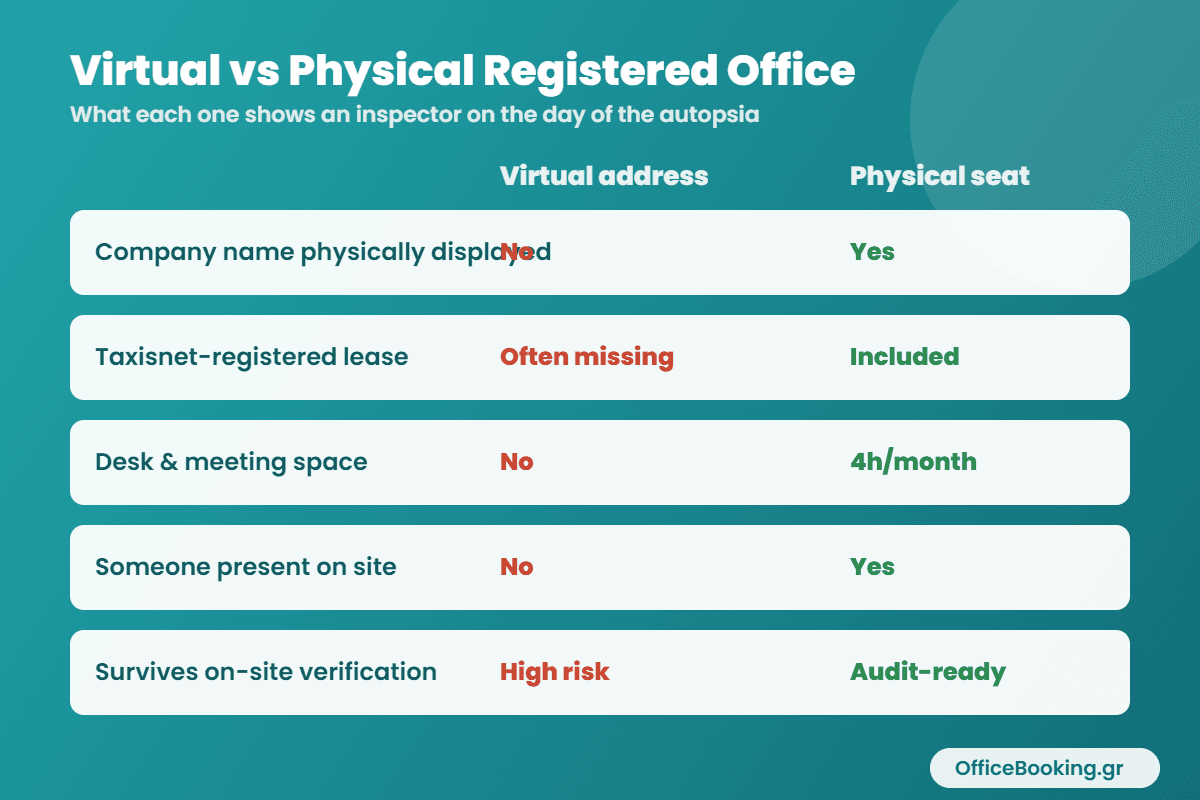
Virtual vs physical registered office: detailed comparison
| Criterion | Virtual office | Physical registered office |
|---|---|---|
| Physical substance | No | Yes (locker + shared desk) |
| Survives a DOY inspection | Doubtful | Yes |
| Business name at the location | No | Yes |
| Electronic lease | Rarely | Yes, on Taxisnet |
| Mail handling | Rarely | Daily, scanned |
| Cost | Low | ~1/10 of an office (€59.90/mo) |
How much a physical registered office costs
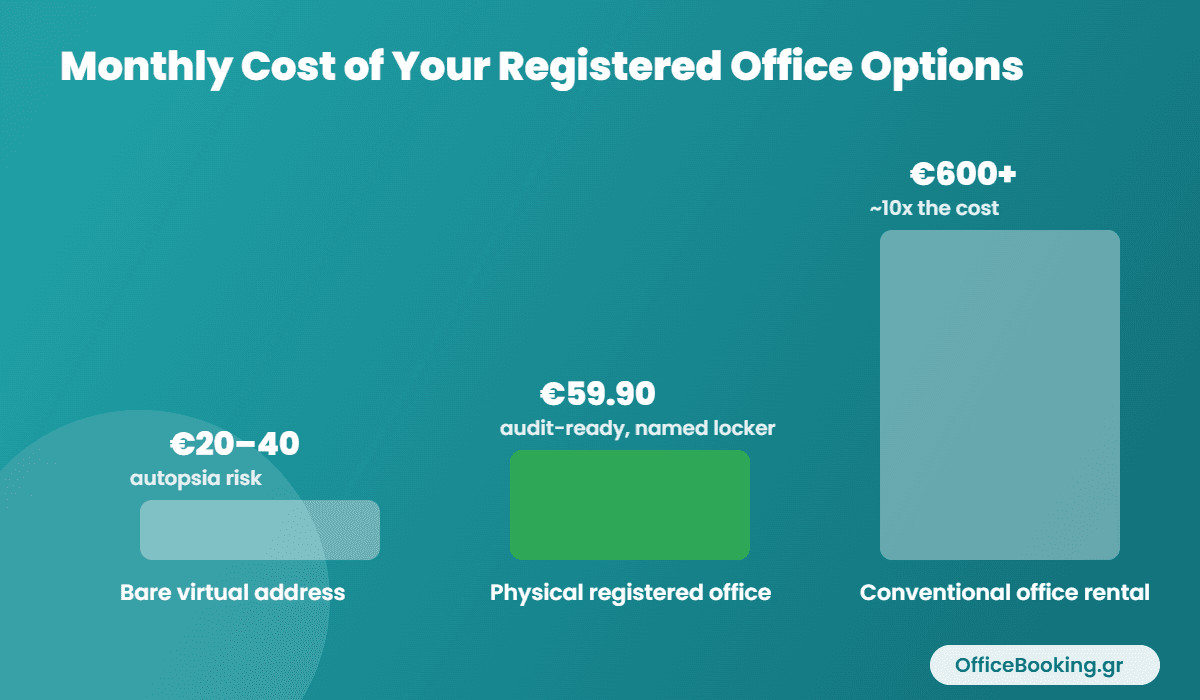
One of the supposed advantages of a virtual office is low cost. But a physical registered office isn’t expensive: at OfficeBooking.gr it starts from €59.90 per month (€48.30 + VAT), with flexible monthly payment — about 1/10 of the cost of a traditional office.
Given that a typical office costs €5,000+ a year in rent, deposit and utilities, the difference is huge. Compared with a virtual office, the small extra you pay buys you real legal security.
Step by step: a legal office in 24 hours
- Check availability and confirm your activity is eligible.
- Receive and accept the electronic lease through Taxisnet.
- Your personal locker with your business name is activated.
- Start or amend your registered office at the DOY — it can be active in up to ~24 hours.
The whole process is remote, with no bureaucracy, and replaces a risky virtual office with a physical registered office that stands up to any inspection.
Who should choose what
If you just want a cheap address and aren’t worried about audit risk, a virtual office seems convenient at first. But if you want to operate legally and worry-free — especially as a freelancer, e-shop or dropshipper who can be audited at any time — a physical registered office is the safe choice, at roughly the same cost.
You don’t have to choose between saving money and staying legal. With a physical registered office you get both, leaving behind the risks of a plain virtual office.
Mail handling and professional image
A point often ignored when choosing a virtual office is mail. Documents from the DOY, notices and official correspondence arrive at the declared address. If that’s a virtual office with no real handling, you risk losing important documents and deadlines.
With a physical registered office, every document is scanned and forwarded to your email the same day, while originals stay safe in your locker. Beyond legality, this gives you a serious professional image with clients, suppliers and banks.
Common myths about the virtual office
The most widespread myth is “a virtual office is enough as long as I’m never audited”. In reality, audits happen without warning, and the lack of physical substance leaves no room. A second myth is that “all address solutions are the same” — a simple mailbox is very different from a physical registered office with a locker, lease and right to use space.
Finally, many believe a physical office costs as much as renting one. As we saw, the cost is about 1/10 of an office, making a physical registered office the most sensible upgrade over a risky virtual office.
Virtual office, co-working or business center?
There are several options for a company address. A business center offers a full office at a high monthly cost. A co-working space gives you a desk, but doesn’t always focus on the legal coverage of your address. A simple mailbox provides only an address, with no substance.
A physical registered office sits exactly in the gap: it combines the low cost of a simple address with the real presence of an office, through a locker and a right to use a shared space. It is the balance between economy, legality and flexibility that a plain virtual office can’t offer.
What you need to declare your registered office
The process is simpler than most people think. In general you need your business or personal details for the start-up, the electronic lease issued and posted on Taxisnet, access to your Taxisnet credentials to accept it, and coordination with your accountant for the start or amendment at the DOY.
With an organised solution, all of the above is completed quickly and remotely. Within hours you have a physical registered office that is ready, active and audit-proof, without leaving your home or office.
Why physical presence matters for clients and banks
Beyond the tax office, a real professional address builds trust. Clients, suppliers and banks treat a business with a serious, named registered office differently from one that looks temporary. Your registered office is, in effect, part of your image in the market.
When you send an invoice or open a business bank account, your address says something about how organised your company is. A physical registered office with a locker, space and mail handling reinforces that image at a fraction of the cost of a traditional office.
The advantage of an office in Heraklion
Our office is located in Heraklion, Crete, in a real working space. That means a fixed, verifiable address bearing your business name, regardless of where you live or travel. In the event of an inspection, there is a specific location an inspector can visit and confirm your presence.
This local footprint, combined with remote management, gives you the best of both worlds: a stable physical registered office and full flexibility in your day-to-day work.
How to choose the right solution
Before you decide, evaluate four things: legality (is there an electronic lease?), physical substance (is there a real space and locker?), mail handling (will you actually receive your documents?), and flexibility (is there a monthly option or a long lock-in?).
When all four are covered, you have a solution you won’t need to change again. That is exactly the philosophy behind a physical registered office: a complete, affordable and legal choice from day one, instead of a cheap virtual office you may regret.
Frequently asked questions
Is a virtual office illegal in Greece?
The problem isn’t the term, but the lack of physical substance. A virtual office with no real space can be treated as an invalid registered office in an audit. A physical registered office solves exactly that.
Can I switch from a virtual office to a physical one?
Yes. You amend your registered office at the DOY, declaring the new physical address with the electronic lease. The process is quick and fully remote.
How fast is a physical registered office activated?
Your office can be active on Taxisnet in up to ~24 hours after the paperwork is completed.
Do I need to be present at the space every day?
No. The 4 hours of shared desk use per month are a right, not an obligation. What matters in an audit is the existence of a real, named presence — the locker and the space — not your constant physical attendance.
Can I have my office in a different city from where I live?
Yes. Your registered office doesn’t have to match your place of residence. Many professionals declare a physical registered office in Heraklion while living or travelling elsewhere, precisely because the process is remote.
Can a bank refuse my account because of a virtual office?
Yes, this happens in practice. During onboarding and periodic reviews, banks and payment providers verify that your declared seat corresponds to a real place of business. An address that resolves to a bare mail-forwarding service raises compliance flags and can delay or block the account. A physical registered office with a Taxisnet-registered lease and your company name on the premises gives the compliance officer exactly the evidence they ask for.
How fast can I move from a virtual address to a physical registered office?
The OfficeBooking.gr seat is typically active in about 24 hours: the concession is signed, registered on Taxisnet, and your named locker is prepared at Anaxagora 23, Heraklion. The change-of-seat declaration to the tax office is a separate administrative step — ask your accountant to file it, since filings sit outside the seat service itself.
A real savings example
Let’s look at simple numbers. A freelancer renting a small office at €400 a month spends €4,800 a year, before deposit and utilities. With a physical registered office at €59.90, the annual cost drops to about €719. The difference, over €4,000 a year, can be reinvested in the business.
For an e-shop or dropshipper that doesn’t need a physical store, the saving is even more logical: you pay only for what you actually need — a legal, reliable registered office that holds up in an audit.
Red flags that make a virtual office fail an inspection
Inspectors are trained to recognise addresses that exist only on paper. The classic red flags: dozens of unrelated companies declared at the same suite with no signage for any of them; no lease registered on Taxisnet, or a “service agreement” that grants no actual use of space; nobody on site who can speak for your business; and mail piling up unopened. Any one of these invites the conclusion that the seat is fictitious — and a fictitious seat can void VAT deductions and trigger fines.
The fix is not more paperwork but real infrastructure. A physical registered office answers each flag directly: your company name is displayed on a personal locker, the concession is registered on Taxisnet, staff are present during business hours, and correspondence is logged and forwarded to you.
How banks, clients and platforms see your registered office
The DOY is not the only party that checks your address. Banks run seat verification during account opening; payment processors and marketplaces (Stripe, PayPal, Amazon, Skroutz) ask for proof of business address; and B2B clients quietly look you up before signing. An address that maps to a real building with a real reception reads as an established business. One that maps to a virtual mailbox provider reads as a shell.
This reputational layer is where the physical registered office quietly pays for itself: one address that satisfies the tax office, the bank’s compliance team, and the client doing due diligence — for €59.90 a month instead of a €600+ office lease.
Switching from a virtual address to a physical registered office
If you are already declared at a virtual address, upgrading is a low-friction, reversible-free process. First, activate the new seat — with OfficeBooking.gr the concession is signed and registered on Taxisnet in about 24 hours. Second, have your accountant file the change-of-seat declaration with the tax office; this is standard practice and does not interrupt your operations. Third, update your invoicing details, bank records and GEMI entry to the new address.
There is no penalty for the switch itself, and the timing is entirely yours — though most owners make the move before an audit letter arrives rather than after. For the declaration mechanics and any sector-specific requirements, rely on your accountant; for the seat itself, the infrastructure is ready the next working day.
Keeping your physical registered office audit-ready over time
Choosing the right seat once is half the job; keeping it verifiable is the other half. Three habits cover almost everything. Keep the concession active: the OfficeBooking.gr seat renews monthly, so the Taxisnet registration never lapses as long as the service runs. Keep the paper trail: every letter received and forwarded from your locker is dated evidence that the address genuinely operates — do not delete the notifications. Keep your registrations aligned: whenever you change activity codes, add a branch, or restructure, confirm with your accountant that the declared seat still matches what GEMI and the tax office have on file.
Owners who follow these three habits walk into an inspection with nothing to prepare, because the evidence has been accumulating on its own. That is the practical difference between an address you rent and infrastructure that works for you: the first needs defending, the second defends itself — at about one tenth of the cost of a conventional office, in a building with real staff in Heraklion, Crete.
Conclusion
A virtual office sounds economical, but its real cost shows up in an audit. With a legal physical registered office that has real substance, you keep the flexibility and remove the risk. Read our FAQs, learn more about a DOY audit with a digital office, or contact us to activate your office on Taxisnet in up to ~24 hours. This information is provided for general guidance; always consult your accountant.