

A registered office for a startup in Greece is the first legal box every new founder has to tick before issuing a single invoice. Whether you are launching an IKE for your next SaaS product or starting solo as a fintech consultant, the seat you declare on Taxisnet is not just a formality — it is the address the tax authority (AADE) can physically inspect, and it directly affects how much cash you burn in your fragile first months.

Do you really need a registered office for a startup in Greece?
Yes. Under Greek law, every business — from a single-member IKE to a sole proprietorship — must declare a professional seat (έδρα) when it registers with the tax office and GEMI. That seat has to be a real location the authorities can visit. For anything outside the seat itself — your KAD activity codes, VAT, and bookkeeping — talk to your accountant; our job is strictly to give you a compliant, audit-ready address.
The problem with a traditional office lease for founders
The instinctive move is to rent a small office. For an early-stage startup that is usually the wrong call. A commercial lease in a Greek city easily runs several hundred euros a month, demands a multi-month deposit, ties you into a one- or two-year contract, and adds utility bills on top. You end up paying for an empty room while your team works remotely from laptops. That capital is exactly what your startup needs for product and marketing, not for square metres you rarely use.
What a physical registered office in Greece actually gives you
Our solution is a real physical registered office in Greece, not a “virtual address” on paper. You get a named locker carrying your company name at Anaxagora 23, Heraklion, Crete, four hours per month of shared-desk time, and a legal seat properly filed on Taxisnet. Because there is a genuine space and documents in your company’s name, the seat survives an on-site audit (αυτοψία).
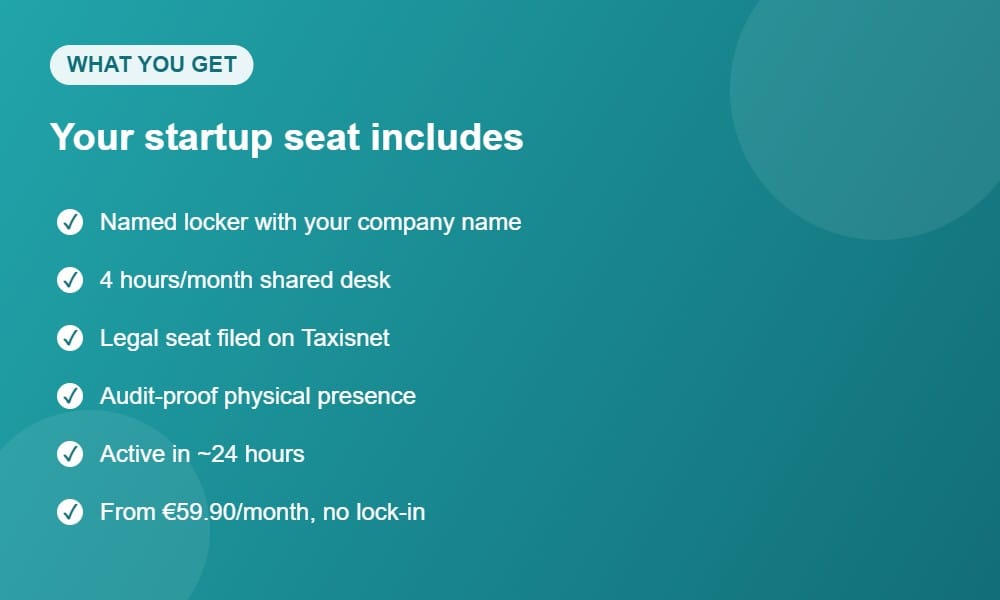
- Named locker with your company name at a real address.
- 4 hours/month of shared desk to be present during an inspection.
- Legal seat filed on Taxisnet, valid for an IKE or sole proprietorship.
- Active in roughly 24 hours, billed monthly with no long-term lock-in.
Startup registered office cost: the real numbers
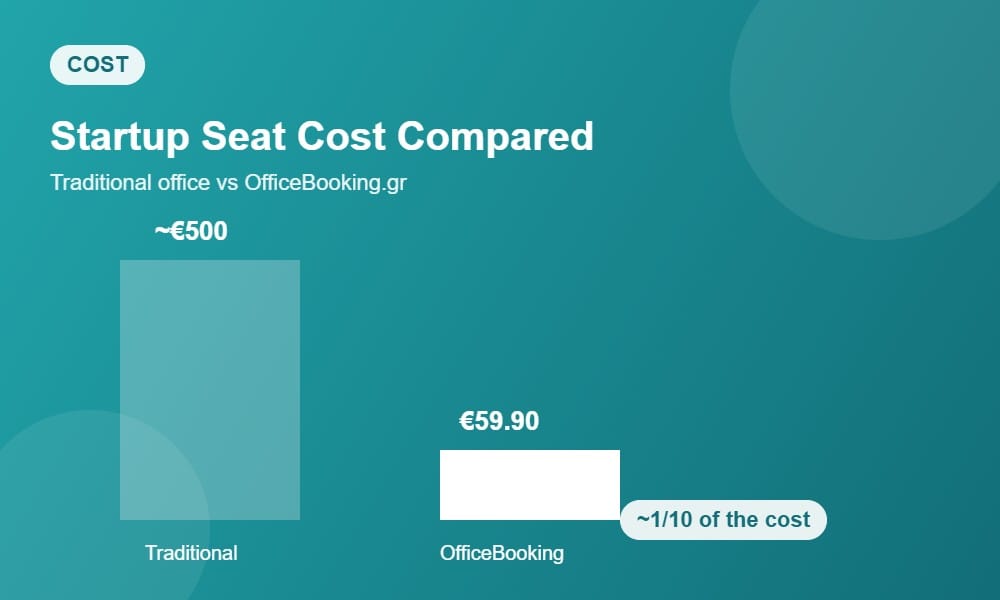
The startup registered office cost with OfficeBooking.gr starts at €59.90 per month (€48.30 + 24% VAT). Compare that with a traditional lease and the difference is dramatic — roughly one tenth of the cost, with none of the deposits or long commitments.
| Option | Typical monthly cost | Commitment | Audit-proof |
|---|---|---|---|
| Traditional office lease | ~€500+ | 1–2 years | Yes, but costly |
| Cheap “virtual address” | €10–20 | Varies | No — fails αυτοψία |
| OfficeBooking.gr seat | from €59.90 | Monthly, no lock-in | Yes — real presence |
Registered office for an IKE company vs a sole proprietorship
Most founders choose between an IKE and a sole proprietorship. A registered office for an IKE company works exactly the same way with us as a seat for a sole trader: the address is declared as your legal seat, and you can use it on contracts, your website and invoices. If you mainly work from home or cafés, our guide on a registered office for freelancers in Greece covers the same logic. Still unsure whether you even need premises? Read Do I need a physical office in Greece?
Why a virtual address fails a tax audit
Cheap “virtual office” addresses sold online have no real physical substance, so they collapse the moment an inspector shows up. AADE checks whether the declared address actually hosts a space and company documents — you can read the official rules on the AADE website. A seat that cannot pass an on-site check can trigger fines and even revocation of your business start. See our full breakdown in Virtual vs Physical Registered Office.
How to get your seat in 3 steps
Setting up a registered office for a startup in Greece with us is deliberately simple and fast.
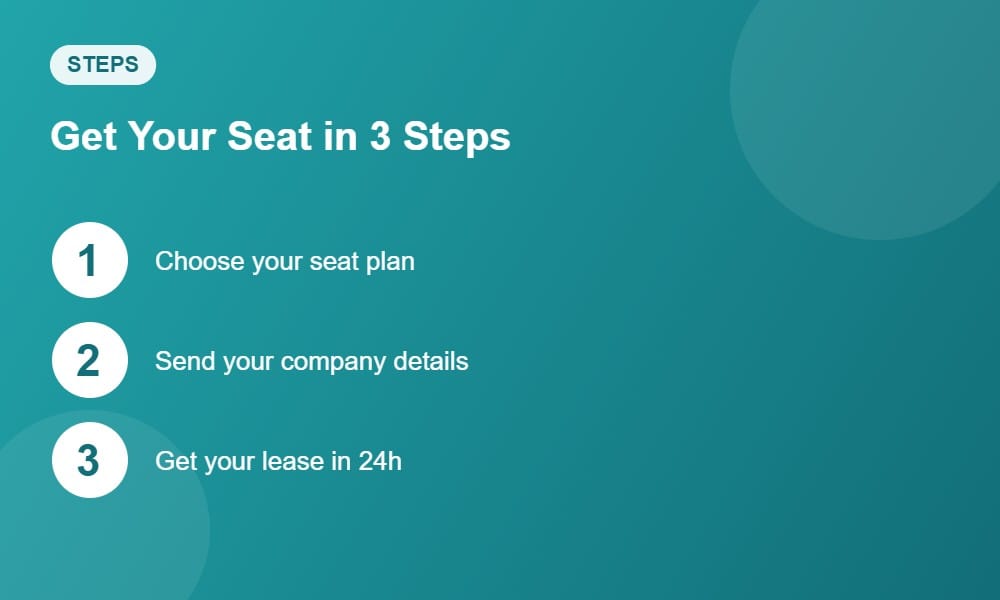
- Choose your seat plan online.
- Send us your company details.
- Receive your lease agreement, usually within 24 hours.
A flexible registered office for founders who scale
The biggest advantage of a flexible registered office for founders billed monthly is the freedom to exit. If in eighteen months you raise funding and want your own office, you simply file a change of seat — no two-year lease dragging you down. If you decide to stay lean and remote, the same seat covers you indefinitely. This flexibility is designed for the uncertainty of a startup’s early years, where the only certainty is that things will change.
Who is this ideal for?
A SaaS founder working from a laptop needs a legal seat to invoice B2B clients without renting an empty room. A fintech or marketing agency starting with two or three remote people wants a professional address on contracts and website, but no fixed rent. A dropshipper or e-shop owner needs a seat that survives an audit, since AADE increasingly checks online activity.
Foreign founders and expats setting up in Greece get a compliant local address without relocating. In every case, a physical registered office in Greece lets you pay only for what you actually need.
Understanding the Greek company seat (έδρα)
In Greece the legal seat, or έδρα, is the official address where your business is considered to be established. It appears in the GEMI business registry, on your Taxisnet profile, and on every official document your company issues. It is the address to which the tax office, social-security bodies and courts send correspondence, and — crucially — the place an inspector can turn up to verify that your business really exists.
For a startup, the seat is therefore not a cosmetic detail but the anchor of your entire legal and tax identity. Choosing a weak or fake address at the start creates a liability that follows the company for years, while choosing a solid registered office for a startup in Greece gives you a stable foundation you never have to worry about again.
Registered office, business address and virtual office: the terms explained
Founders researching this topic run into three overlapping terms, and the differences matter. A registered office is your legal seat as filed with the authorities. A business address is any address you use commercially — it may or may not be your legal seat.
A virtual office usually means mail handling at an address with no genuine physical space allocated to you, which is precisely what fails a Greek tax audit. What OfficeBooking.gr provides is a true legal seat with real, allocated presence — the strongest of the three, at a fraction of the price of renting your own premises.
Documents you need to declare your seat
To declare your seat on Taxisnet you generally need a lease agreement (or proof of use) for the address, your company or personal tax details, and the relevant GEMI and tax-office forms. We provide the signed lease for your legal seat; your accountant handles the tax filings themselves.
Because the paperwork is standardised, a startup can move from decision to declared seat in about a day, rather than the weeks a traditional office search can take. Keep a digital copy of your lease with your other incorporation documents so it is ready if an inspector asks for it.
How the flexible model protects your cash runway
Runway is everything for an early-stage company. Every euro locked into rent and deposits is a euro you cannot spend on building your product or acquiring your first customers. By replacing a multi-hundred-euro lease with a seat from €59.90 per month, a startup can preserve thousands of euros over its first year — money that can fund a developer, an ad campaign, or simply a longer runway before you need to raise.
Because there is no deposit and no multi-year commitment, the seat behaves like a small, predictable subscription rather than a fixed liability on your balance sheet. This is what makes a flexible registered office for founders so well suited to the startup model, where speed and optionality beat fixed assets.
Common mistakes startups make with their seat
The most frequent mistake is treating the seat as an afterthought and declaring a home address, only to discover that this exposes personal property to business inspections and, in some buildings, breaches the rules of the property. The second is buying the cheapest “virtual address” online without checking whether it can survive an αυτοψία — a false economy that can cost far more in fines than it ever saved. The third is signing a long office lease “to look serious” before the business has revenue to justify it.
A properly structured physical registered office in Greece avoids all three: it is compliant, audit-ready, and cheap enough that it never becomes a burden. When in doubt about the tax implications of any of these choices, consult your accountant before you file.
Why Heraklion, Crete is a smart base for your seat
Our seat is located at Anaxagora 23 in Heraklion, Crete. For a modern startup that operates online, the physical city of your legal seat rarely matters for day-to-day work — what matters is that the address is real, monitored and audit-proof. Basing your seat in Heraklion gives you exactly that at a lower cost than a prestige address in central Athens, with the same legal standing across Greece. Your clients see a professional Greek business address; the authorities see a genuine, inspectable location.
Registered office and your GEMI registration
When you incorporate in Greece, your company is entered into the General Commercial Registry (GEMI), and the address you declare there is your legal seat. If that address later proves invalid — for example a virtual address that cannot be inspected — you may be forced to file a change of seat, pay to correct the registry, and in the worst case face penalties for having declared a non-compliant location.
Starting with a genuine registered office for a startup in Greece means your GEMI entry is correct from day one, so you never have to unwind it. Your accountant files the GEMI paperwork; we simply give you the compliant address and lease that entry depends on.
Frequently overlooked benefits of a proper seat
Beyond compliance, a real seat quietly improves how your startup is perceived. Suppliers and B2B clients running due diligence see a legitimate business address rather than a residential flat. Banks and payment processors, which increasingly verify company addresses during onboarding, are less likely to flag your application.
And because your home address stays private, you avoid publishing where you live on invoices, contracts and public registries — a genuine privacy and safety benefit for solo founders. These advantages come built in with a physical registered office in Greece, at no extra cost beyond your monthly seat fee.
Planning ahead: changing or upgrading your seat later
Startups pivot, relocate and grow, and your seat should not get in the way. If you eventually open your own office, you file a change of seat and move on — the monthly, no-lock-in nature of our service means there is no penalty for leaving. If you expand to a second activity or add partners to your IKE, the same seat continues to serve as your legal address.
Some founders even keep our seat as their official έδρα while renting separate coworking space for the team, keeping their legal and operational addresses cleanly separated. The point is that a flexible registered office for founders adapts to your company instead of forcing your company to adapt to a lease.
How the startup registered office cost compares over a year
It is worth looking at the startup registered office cost across a full year rather than a single month. A traditional office at roughly €500 per month plus a two-month deposit means well over €7,000 committed in year one before utilities. Our seat at €59.90 per month totals under €750 for the year, with nothing locked up as a deposit.
For a bootstrapped founder, that gap can be the difference between running out of runway and reaching your next milestone. For a funded startup, it is budget redirected from dead space to growth. Either way, the maths strongly favours a lean, compliant seat in the early stages.
Getting started today
Setting up your seat does not need to wait for incorporation to be finished. Many founders arrange the registered office for a startup in Greece in parallel with the rest of their company formation, so the address is ready the moment the accountant files with GEMI and the tax office. Reach out through our contact page with your basic details, choose the plan that fits, and you can have a signed lease — and a legal seat you never have to second-guess — within a day.
Registered office for a startup in Greece: a quick recap
To sum up, a registered office for a startup in Greece is a legal requirement, not an optional extra. Skipping it or faking it is simply not worth the risk.
A compliant registered office for a startup in Greece costs far less than a lease. With OfficeBooking.gr it starts at €59.90 per month and stays flexible.
Above all, a real registered office for a startup in Greece survives an audit, because it is backed by genuine physical presence in Heraklion.
If you are still comparing options, remember that the cheapest registered office for a startup in Greece is worthless if it collapses under inspection. Choose a seat with real substance.
Frequently Asked Questions
Is it legal to place my IKE’s seat in a shared office?
Yes. As long as there is a real, signed lease and genuine physical presence — a named locker and shared-desk access — the seat is fully legal and audit-proof.
How fast can I get the lease?
Usually in less than 24 hours from the moment you send us the required details.
What if AADE inspects and I am not there?
Your locker and company signage prove the physical presence of your documents, and you can use your 4 free monthly hours of shared desk to attend in person.
Is there a minimum contract length?
No. Billing is monthly with no long-term commitment, so your startup can grow freely.
Can I use the address on my website and invoices?
Yes. It is a real professional seat, so you can use it on your site, business cards, contracts and invoices.
Does the seat work for a foreign founder or expat?
Yes. Foreign founders setting up a Greek company can use the seat as their legal address without relocating, provided their tax registration is in order — check the specifics with your accountant.
Is mail handling included in the €59.90 price?
Your named locker holds correspondence delivered to the seat. Ask our team about the exact mail-handling terms for your plan via the contact page.
Conclusion: the smart move for your launch
For a new venture, a registered office for a startup in Greece from OfficeBooking.gr is the low-risk, low-cost way to stay fully compliant from day one. You get a real, audit-proof seat from €59.90/month, active in about 24 hours, with no lock-in. Talk to our team or check the FAQs to get started.